
INTRODUCTION
The innovation challenge haunts every boardroom.
B2B executives know they must innovate to survive, yet most innovation efforts collapse under their own weight. The statistics are sobering. According to Harvard Business School's Clayton Christensen, 95% of product innovations fail (MIT Professional Education, 2023). Research from Bain suggests that between 70% and 90% of all innovations never deliver their promised value (Rigby, First and Boyd, 2023).
Now, as we move through 2026, the stakes have escalated dramatically. Artificial intelligence is not merely another technology trend. It represents a fundamental acceleration of market disruption. McKinsey's latest State of AI research shows that 88% of organisations now use AI in at least one business function, up from 78% just a year ago (McKinsey & Company, 2025). Yet only one-third are successfully scaling AI across their enterprises. The consultancy estimates that generative AI could unlock between $2.6 trillion and $4.4 trillion in additional value (Aristek Systems, 2025), but observes that 2026 marks a critical inflection point. As one analysis noted, AI is moving from experimentation to operational responsibility (Synovia Digital, 2025). Companies that cannot execute will not survive the transition.
VUCA 2.0
This is the VUCA environment on steroids. Volatility, Uncertainty, Complexity, and Ambiguity have always challenged innovation efforts. AI amplifies each dimension. Markets shift faster. Customer needs evolve in real time. Competitive threats emerge from unexpected quarters. The complexity of delivering integrated solutions across technology platforms, regulatory environments, and organisational boundaries has reached unprecedented levels.
The pharmaceutical industry illustrates this perfectly. Companies historically relied on New Chemical Entities to drive (patent-protected) growth. Those days are fading. Today's healthcare customers face pressures that compound daily. Payers demand value-based outcomes with algorithmic precision. Providers wrestle with AI-enabled diagnostics while managing cost containment. Patients expect personalised care pathways informed by genetic data and real-time monitoring. The innovation that matters now is not just the molecule. It is the complete solution that addresses these layered, interconnected needs while navigating the AI-transformed landscape.
Most companies respond to this complexity by creating more bureaucracy. They establish innovation committees. They hire Chief Innovation Officers. They launch ideation platforms and internal accelerators. The problem is not a lack of ideas or resources. The problem is a fundamental misalignment between innovation efforts and market realities.
The answer sits closer than most executives realise. Key Account Managers already occupy the strategic intersection where innovation must succeed. They are not the only players in the innovation game, but they are uniquely positioned to make innovation work in conditions of extreme uncertainty. Here are three ways that Key Account Management should be at the heart of your innovation strategy.

The 3 Ways KAM powers B2B innovation
1. Effective innovation is built on meeting customer needs
For half a century, the evidence has been consistent. Products fail when they do not meet genuine customer needs. This should not be surprising, yet companies persist in developing solutions before they fully understand the problems.
In 2026, with AI reshaping how customers operate, this risk has intensified. Customer needs are no longer static targets to be captured in annual surveys. They evolve continuously as organisations deploy new technologies, restructure operations, and respond to competitive pressures. Traditional market research cannot keep pace.
Key Account Managers live in the customer's world. They do not visit occasionally. They do not conduct annual surveys. They are embedded in the operational reality of their most important customers. They understand not just what customers say they need, but what they actually struggle with day to day. This distinction matters enormously.
Traditional market research asks customers what they want. Key Account Managers observe what customers do. They see where processes break down. They witness the workarounds. They understand the political dynamics that shape buying decisions. They know which problems executives care about enough to fund solutions for. They see firsthand how AI implementations succeed or fail, where automation creates new pain points, and which human capabilities remain irreplaceable.
The Value-Based KAM Framework formalises this advantage. Rather than treating customer understanding as a one-time event, it creates a systematic process for discovering, quantifying, and prioritising customer needs. The framework moves through seven distinct steps across three phases: Diagnose, where you map customer operations and identify value gaps; Design, where you construct tailored offers; and Deliver, where you execute and measure outcomes.
When Key Account Managers drive the needs discovery process, innovation stops being a leap in the dark. It becomes a calculated response to documented, validated customer problems. The innovation pipeline fills with ideas that have already passed the market test. They are grounded in customer economics, not internal enthusiasm.
2. Innovation must beat the competitor's offer
Even brilliant innovation fails if it cannot win in competitive situations. Yet most innovation teams operate in relative isolation from competitive intelligence. They know their own capabilities. They understand their own technology. They rarely grasp what competitors are doing at the account level, where deals are won and lost.
Key Account Managers possess competitive intelligence that innovation teams cannot access through secondary research. They know which competitors are winning and why. They see competitor proposals. They hear the pitch. They understand the pricing structure, the service commitments, and the relationship history that shapes customer preferences. In 2026, as AI capabilities become table stakes across industries, this ground-level intelligence becomes even more critical. The differentiation that matters often lies not in the technology itself but in how it integrates with customer workflows, how implementation support is delivered, and how ongoing value is demonstrated.
This intelligence is strategic gold for innovation. It reveals where competitors are vulnerable. It identifies the threshold requirements that any innovation must meet simply to be considered. It exposes the distinctive value that would change customer preferences. Without this ground-level competitive understanding, innovation teams risk building products that are interesting but not compelling in actual buying situations.
The pharmaceutical example is instructive again. A new therapy might have superior clinical data. But if a competitor has locked in formulary position, established patient support programs, built strong relationships with key opinion leaders, and deployed AI tools that streamline prior authorisation processes, clinical superiority alone will not win. Innovation must address the complete competitive landscape, not just the technical specification.
Key Account Managers see this landscape clearly. They can tell innovation teams what good looks like from the customer's perspective. They can stress-test innovation concepts against real competitive alternatives. They can identify which features matter and which are merely nice-to-haves. This feedback loop between innovation and the competitive front line is not optional. It is essential.
3. Innovation is only useful when it can be sold and delivered to paying customers.
This is where most innovation dies. Not in the lab. Not in the concept phase. But in the commercialization and implementation moments, when someone must translate technical possibility into customer value, execute the sale, and then make the solution work in the messy reality of customer operations.
Research from Harvard Business Review identified that innovation projects most commonly fail during the handoff from innovation teams to business units (Kirsner, 2017). The innovation is technically sound. The market research is promising. But the transition to scaled commercial launch stumbles because nobody owns the difficult work of making it real for customers.
Key Account Managers are the bridge. They do not just identify needs and provide competitive intelligence. They own the commercial relationship and the implementation accountability. They understand customer buying processes. They know who must approve. They can navigate the political complexity of large organizational purchases. They can articulate value in terms that resonate with economic buyers, not just technical users.
But here is what separates Key Account Management from every other role in the innovation value chain: Key Account Managers are measured and judged by both their customers and their own organizations on whether the innovation actually delivers value in practice. This dual accountability creates a forcing function that other functions simply do not face.
When innovation fails to perform, it is the Key Account Manager who receives the call. When implementation stalls, it is the Key Account Manager who must diagnose what went wrong and get things back on track. When promised benefits fail to materialize, it is the Key Account Manager whose credibility suffers and whose commercial relationship deteriorates. This is not theoretical responsibility. This is career-defining accountability.
Because of this accountability, Key Account Managers do not simply hand off innovation to customers and move to the next opportunity. They own the change management process. They work with customer stakeholders to overcome resistance. They identify the training gaps. They troubleshoot the integration issues. They measure adoption rates. They quantify the value delivered. They make adjustments when initial approaches prove insufficient.
In 2026, with AI implementations creating unprecedented change management challenges, this role becomes even more critical. Customers are not just buying new products. They are transforming how work gets done. They are redefining roles, reimagining processes, and restructuring organizations. The technical solution might be sound, but the human and organizational dimensions determine success or failure. Key Account Managers navigate these dimensions because their own success depends on it.
The Value-Based KAM Framework addresses this explicitly in its Deliver phase. It is not enough to design a compelling offer. You must deliver it in a way that captures measurable value for both the customer and your own organisation. This requires commercial discipline, account planning, relationship management, and a relentless focus on execution. It requires someone who can orchestrate complex sales processes, maintain momentum through lengthy procurement cycles, and then ensure successful implementation and adoption.
The Value-Based KAM Framework
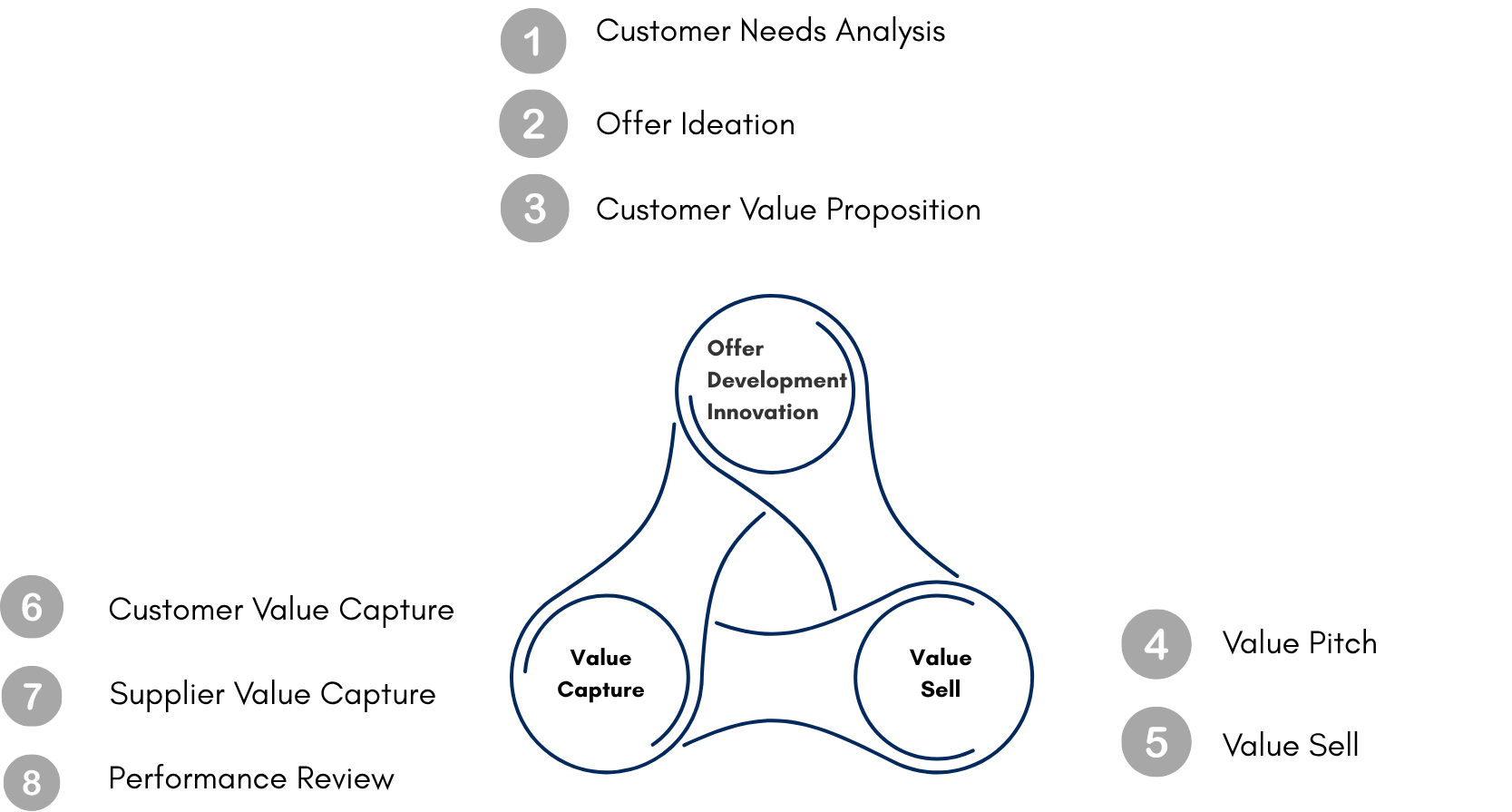
Davies / Value-Matters 2025
Who does that? The Key Account Manager. And they do it knowing that both their customer and their own leadership team will judge them on actual results, not projected potential. This accountability transforms innovation from an interesting possibility into business performance.
Innovation without commercialization and implementation is simply research. It might be interesting. It might even be important. But it does not drive growth. Key Account Managers convert innovation from potential to performance. They take the new product, the new service, the new business model, and they sell it to customers who matter. Then they make it work. Then they prove the value. Then they expand it.
Final thoughts..
The innovation crisis is not going away. If anything, it is accelerating. Markets are more volatile. Customer needs are more complex. Competitive intensity is increasing. AI is compressing decision cycles and raising performance expectations. Companies that cannot innovate effectively will not survive the next decade.
The good news is that the solution is not some exotic new methodology. It is sitting in your organisation right now. Your Key Account Managers have the customer knowledge, competitive intelligence, commercial capability, and implementation accountability to make innovation work. The question is whether you will leverage them.
Most companies still treat Key Account Management as a relationship exercise. They measure it by customer satisfaction scores and retention rates. These matter, but they miss the larger opportunity. When you integrate Key Account Management into your innovation strategy, you transform it from a cost centre focused on retention into a growth engine that drives profitable innovation.
This is not just theory. Organizations that adopt a Value-Based approach to Key Account Management report measurably better innovation outcomes. They launch products that customers actually buy. They build competitive advantage that endures. They create value that flows to both customers and shareholders. Most importantly, they ensure that innovation delivers results, not just promises.
The 50-year pattern of innovation failure can be broken. But it requires honest acknowledgment that the problem is not a lack of creativity or resources. The problem is a disconnect between innovation efforts and market reality. Key Account Managers eliminate that disconnect. They make innovation customer-centric, competitively informed, commercially viable, and operationally successful.
In the VUCA environment of 2026, where AI accelerates both opportunity and disruption, this integration of innovation and Key Account Management is not optional. It is essential. The organisations that recognise this will thrive. Those that persist with innovation approaches disconnected from the accountability and execution discipline of Key Account Management will join the 95% that fail.
If you are serious about innovation, start by having a serious conversation about the role of Key Account Management in your innovation process. The statistics suggest you cannot afford to wait.
Ready to transform how your organisation approaches innovation?
Let's talk about how Value-Based Key Account Management can unlock your innovation potential, ensure successful implementation, and drive measurable growth in 2026 and beyond. Email me to explore what this could mean for your business.
email - [email protected]
References
AIM Institute (2021) How long have we failed to understand customer needs in new product innovation?
Aristek Systems (2025) AI 2025 Statistics: Where Companies Stand and What Comes Next.
Kirsner, S. (2017) 'The Stage Where Most Innovation Projects Fail', Harvard Business Review, 11 April. McKinsey & Company (2025) The state of AI in 2025: Agents, innovation, and transformation.
MIT Professional Education (2023) Product Innovation: 95% of new products miss the mark.
Rigby, D., First, Z. and Boyd, M. (2023) 'How Corporate Purpose Leads to Innovation', Harvard Business Review, 1 November.
Synovia Digital (2025). The State of AI in 2025: What McKinsey's Data Tells Us About 2026.


Responses