
10 ways that Key Account Managers can use AI to boost their critical thinking skills
INTRODUCTION
The average Key Account Manager juggles seventeen different decisions before their second coffee. Which customer challenge deserves attention first? Is this request strategic or operational? Should we customise this proposal or deploy our standard offering? Each decision carries consequences that ripple through customer relationships, revenue forecasts, and competitive positioning.
Yet here's what nobody admits: most KAMs are winging it. They're relying on instinct, experience, and whatever framework they remember from last month's training session. In an environment where product advantages evaporate in months and customer needs shift quarterly, this approach is increasingly untenable.
Critical thinking isn't some academic luxury. It's the cognitive infrastructure that separates strategic account management from glorified order-taking. And artificial intelligence, far from replacing this capability, can amplify it dramatically. The question isn't whether AI will change how KAMs think. The question is whether you'll harness it before your competitors do.
What is critical thinking?
Let's establish what we actually mean by critical thinking, because the term gets thrown around carelessly.
The landmark 1990 Delphi Report, which gathered 46 experts across multiple disciplines, defined critical thinking as "purposeful, self-regulatory judgment which results in interpretation, analysis, evaluation, and inference, as well as explanation of the evidential, conceptual, methodological, criteriological, or contextual considerations upon which that judgment is based" (Facione, 1990).
That's comprehensive but dense. Paul and Elder (2002) offer a more accessible definition: critical thinking is "the art of analysing and evaluating thinking with a view to improving it." They emphasise that it's "self-directed, self-disciplined, self-monitored and self-corrective thinking" that requires "rigorous standards of excellence and mindful command of their use."
In practical terms, critical thinking comprises five core cognitive skills (Facione, 1990; Dwyer et al., 2014):
- Interpretation: Categorizing and clarifying the meaning of information, statements, or experiences
- Analysis: Identifying relationships between statements, questions, concepts, or other forms of representation
- Evaluation: Assessing the credibility and logical strength of statements or representations
- Inference: Drawing reasoned conclusions and identifying elements needed to draw reasonable conclusions
- Explanation: Articulating results of one's reasoning in a coherent, organized way
Paul and Elder (2002) add that whenever we think critically, we're working with eight fundamental elements of reasoning: purpose, questions, information, concepts, inferences, assumptions, implications, and point of view. Quality critical thinking requires applying intellectual standards to these elements: clarity, accuracy, precision, relevance, depth, breadth, logic, and significance.
Here's what matters for Key Account Managers:
Critical thinking isn't about being clever or contrarian. It's about systematically improving the quality of your reasoning so you make better decisions, develop stronger strategies, and create more value for customers.
Why critical thinking matters for Key Account Managers
Key Account Management demands a peculiar cognitive juggling act. You're simultaneously thinking at three distinct levels, each requiring different skills and perspectives.
The Tri-Stack of KAM Skills
Modern KAM operates across three integrated stacks: Strategic, Commercial, and Operational. Each stack contains four essential competencies, creating twelve skills that effective KAMs must master.
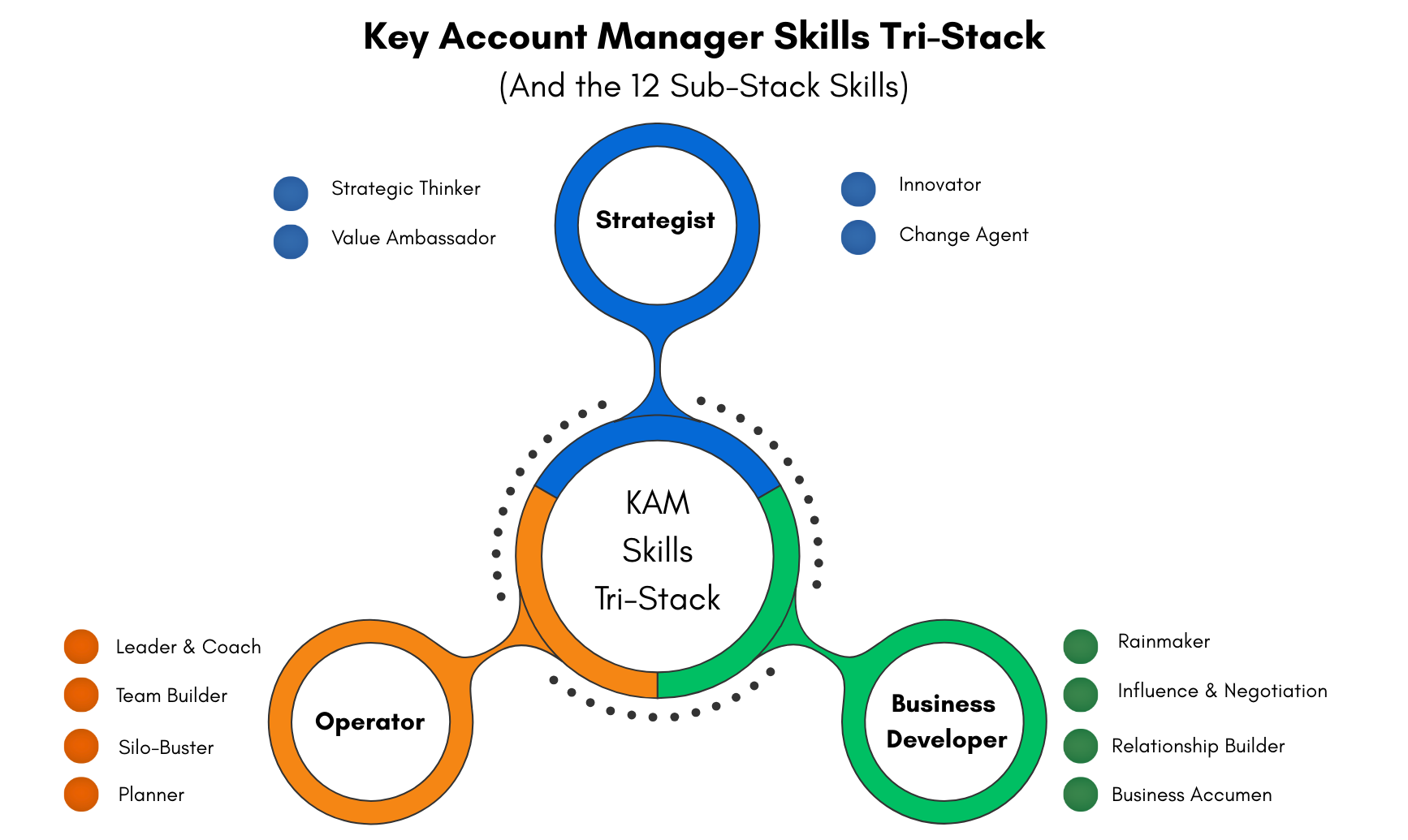
The Strategic Stack:
- Strategic Thinker: Analysing complex systems, identifying patterns, and connecting disparate information to form coherent strategies
- Value Ambassador: Representing and articulating value across multiple stakeholder groups with different priorities
- Innovator: Developing novel solutions for unique customer challenges that competitors cannot replicate
- Change Agent: Understanding organisational dynamics and facilitating transformation across boundaries
The Commercial Stack:
- Rainmaker: Converting strategic opportunities into profitable revenue through consultative engagement
- Influence & Negotiation: Building consensus and reaching mutually beneficial agreements without formal authority
- Relationship Builder: Creating deep, multi-level connections that resist competitive pressure
- Business Acumen: Understanding financial drivers, commercial implications, and value creation mechanisms
The Operational Stack:
- Leader & Coach: Guiding internal and external teams toward shared objectives
- Team Builder: Assembling and coordinating cross-functional resources without hierarchical control
- Silo-Buster: Navigating organisational boundaries and connecting isolated functions
- Planner: Managing complexity, sequencing activities, and coordinating multiple concurrent initiatives
This Tri-Stack model reveals a crucial point: KAMs aren't salespeople with larger territories. They're hybrid professionals operating at the intersection of strategy, innovation, and sales execution.
Three Modes of Working
The Tri-Stack skills come into play depending on what a KAM is actually doing at any given moment:
Strategic work involves developing new value propositions unique to specific customers. When you're engaged in Offer Development and Innovation (ODI), you're creating differentiated solutions that competitors cannot easily replicate. This is where strategic thinking, innovation, and value ambassador skills dominate. Critical thinking here means questioning assumptions about what's possible, evaluating multiple solution paths, and inferring what will create genuine competitive advantage.
Commercial work begins when the customer value proposition has been developed and must be sold. This is the Value Sell phase, where you articulate value, build consensus, and convert opportunities into committed business. Critical thinking in commercial mode means analysing stakeholder motivations, evaluating different messaging strategies, and inferring how decisions will actually get made within the customer organisation.
Operational work involves delivering a value proposition that's already been sold. This is Value Capture territory, where execution excellence, measurement, and continuous improvement matter most. Critical thinking here means monitoring performance indicators, identifying gaps between promised and delivered value, and evaluating whether you're actually capturing the value you've created.
The cognitive challenge is switching between these modes fluidly while maintaining strategic coherence. You can't think like a strategist when you need to execute operationally. But you also can't get trapped in operational details when strategic opportunities emerge
Why critical thinking elevates EVERYTHING
Without disciplined critical thinking, KAMs default to the path of least resistance. They pursue the loudest customer request rather than the most strategically valuable opportunity. They propose standard solutions rather than innovative alternatives. They measure activity rather than outcomes. They optimise for short-term revenue rather than long-term value creation.
Critical thinking breaks these patterns. It forces you to question whether you're solving the right problem, pursuing the right opportunity, or measuring what actually matters. It helps you distinguish among strategic, commercial, and operational challenges and apply the appropriate cognitive approach to each.
Consider this practical example: a pharmaceutical KAM receives an urgent request from a hospital customer to expedite delivery. Without critical thinking, the response is straightforward: promise faster delivery, pressure logistics, and hope it works out.
With critical thinking, the analysis goes deeper. What's the underlying need driving this request? (Interpretation) Is it truly about delivery speed, or about inventory management, budget cycles, or clinical workflow disruption? (Analysis) How credible is their stated urgency versus other competing priorities? (Evaluation) What are the implications if we optimise for speed versus reliability, cost, or other dimensions? (Inference) Which solution approach addresses their real need while creating a competitive advantage we can defend? (Synthesis)
This deeper analysis might reveal that the "delivery speed problem" is actually a forecasting and inventory management challenge. The innovative solution isn't faster trucks. It's an integrated planning system that reduces uncertainty and allows lower inventory levels. That's the kind of strategic insight that transforms transactional relationships into genuine partnerships.
10 critical thinking applications across the Value-Based KAM Framework
Let's map critical thinking to the Value-Based KAM framework systematically. This isn't theory. These are the specific ways skilled KAMs use critical thinking to drive growth through the three-phase process: Offer Development & Innovation, Value Sell, and Value Capture.

Phase 1: Offer Development & Innovation (ODI)
1. Problem Framing Before Problem Solving
Most KAMs jump to solutions before fully understanding the problem. Critical thinking demands that you frame the challenge correctly first.
Use the Paul and Elder elements of reasoning deliberately: What's the actual purpose we're trying to achieve? (Not what the customer initially requested, but what they're ultimately trying to accomplish.) What questions would reveal whether we're solving the right problem? What assumptions are we making about the customer's situation? What point of view are we taking? (The customer's procurement perspective? Their operational reality? Their CEO's strategic concerns?)
This isn't philosophical navel-gazing. Proper problem framing determines whether you develop a commodity solution or a defensible competitive advantage. Critical thinkers interrogate the problem statement until they're confident they understand what needs to be solved.
2. Distinguishing Symptoms from Root Causes
Customers articulate symptoms. They want "better prices", "faster delivery", or "more support." Critical thinking reveals the underlying causes driving these surface requests.
Apply systematic analysis: Is this symptom present across multiple departments or isolated to one area? Did it emerge suddenly or gradually? What changed in their environment that triggered this concern? What evidence supports their interpretation of the problem versus alternative explanations?
When my client (a global medical device manufacturer) key customer report "budget pressure," the common response is to reduce prices. Critical analysis assesses whether the issue is actual budget constraints, procurement performance metrics, upcoming formulary decisions, or pipeline concerns about future products. Each root cause requires a different strategic response.
3. Challenging Conventional Wisdom About Solutions
Every industry accumulates accepted solutions to common problems. Critical thinking questions whether these conventional approaches still create value.
Deliberately seek alternative perspectives: What would a customer in a different industry do with this challenge? What if we couldn't use our standard solution? What emerging technologies or business models might apply here? What assumptions are embedded in "how we've always done it"?
A medical device, KAM, challenging conventional wisdom, might recognise that hospitals don't want better surgical instruments. They want better surgical outcomes, shorter procedure times, and fewer complications. That insight leads to integrated training programs, outcome analytics, and clinical protocol optimisation, rather than incremental hardware improvements.
4. Creating Novel Combinations from Existing Resources
Innovation rarely means invention from scratch. It means combining existing capabilities in new ways that create customer value.
Critical thinking here involves synthesis: What capabilities do we possess that this customer doesn't fully utilise? What resources available in one part of our organisation could address challenges in their organisation? How might capabilities that work in one customer context transfer to another?
Animal Healthcare KAMs excel at this by combining veterinary pharmaceuticals with data analytics, training programs, and business consulting to create integrated livestock health management solutions. None of these elements is individually unique, but the combination creates defensible value propositions.
Phase 2: Value Sell
5. Adapting Messages to Different Stakeholder Logic
Complex B2B sales involve multiple stakeholders with genuinely different priorities. Critical thinking means constructing stakeholder-specific value arguments rather than broadcasting generic messages.
Analyse each stakeholder's reasoning process: What evidence do they find credible? (Financial models? Operational data? Case studies? Peer recommendations?) What criteria drive their evaluation? What risks concern them most? What does success look like from their point of view?
The CFO evaluates ROI and risk mitigation. The Operations Director weighs implementation complexity and workflow disruption. The Innovation Lead considers competitive differentiation and strategic positioning. Same solution, three completely different value conversations.
6. Evaluating Internal Feasibility Before External Commitment
Before proposing bespoke solutions to customers, critical KAMs assess whether their organisation can deliver.
This requires an honest assessment: Do we have the capabilities to do this, or are we hoping we can figure it out? What cross-functional dependencies does delivery create? What would cause this to fail internally? Which organisational antibodies will attack this initiative?
Many KAM failures stem from overselling internally undeliverable solutions. Critical thinking provides the intellectual honesty to say "we can't do this yet" or "we need these internal changes first" rather than making commitments that damage credibility.
7. Reading Organisational Politics and Decision Dynamics
Decisions in large organisations are shaped by both formal processes and informal politics. Critical thinkers read both channels.
Inference skills matter here: Who has formal authority versus actual influence? What unstated agendas are shaping discussions? Which stakeholders are allies, neutrals, or blockers? What recent organisational events might affect decision-making? How do timing and sequence affect outcomes?
A KAM selling to the UK Government or a Law Firm might notice that the formal decision process flows through procurement, but the actual decision is made in a partner meeting three weeks before procurement gets involved. Understanding this political reality changes everything about engagement strategy.
Phase 3: Value Capture
8. Distinguishing Activity Metrics from Value Indicators
Most KAMs measure what's easy to count rather than what actually matters. Critical thinking demands rigorous evaluation of what constitutes genuine value.
Apply the intellectual standard of relevance ruthlessly: Does this metric actually indicate value creation, or just activity? Would this number matter to the customer's CEO or board? Can this metric change without affecting actual business outcomes?
The difference between "we conducted twelve training sessions" (activity) and "reduced onboarding time by 40%, saving 2,400 staff hours annually" (value) is everything. Critical thinkers ensure they capture and communicate the latter.
9. Creating Causal Stories Not Just Data Points
Humans reason through narratives, not spreadsheets. Critical thinking transforms isolated performance data into coherent causal explanations.
This requires explanation: What sequence of events led to these results? Which elements of our solution directly caused which customer outcomes? What would have happened without our intervention? How do we know this outcome wasn't caused by other factors?
When a global energy infrastructure company reports energy cost reductions to a manufacturing client, the critical-thinking KAM explains which system optimisations, behavioural changes, and operational adjustments drove the specific savings. This causal story makes value undeniable and creates the foundation for the next innovation cycle.
10. Recognizing When to Pivot Versus Persist
Not everything works as planned. Critical thinking helps distinguish between initiatives that need refinement and those that need to be abandoned.
Evaluation requires intellectual honesty: What evidence would prove this isn't working? Are we seeing learning progress, or are we repeating the same failures? Are current challenges temporary obstacles or fundamental flaws? What would success look like at this stage, and are we on track to achieve it?
A packaging solutions KAM might recognise that a sustainability initiative isn't gaining traction, not because the solution is wrong, but because it's engaging the wrong stakeholders. That insight triggers a strategic pivot to environmental compliance teams rather than abandoning the initiative entirely.
How AI amplifies critical thinking for Key Account Managers
Artificial intelligence doesn't replace critical thinking. It supercharges it by handling cognitive tasks that humans find tedious or overwhelming, freeing mental resources for higher-level reasoning.
AI as a Reasoning Partner
Modern AI systems like Claude, ChatGPT, and Gemini can serve as cognitive sparring partners. When developing customer solutions, KAMs can articulate their reasoning to AI, which then applies systematic critical thinking frameworks to stress-test assumptions, identify gaps, and suggest alternatives.
Think of AI as having instant access to a colleague who's read every business strategy book, studied every industry, and never gets tired of asking "but have you considered...?" This external perspective catches blind spots that internal thinking misses.
Pattern Recognition at Scale
Critical thinking requires identifying patterns across complex information. AI excels at processing massive data sets to surface trends, correlations, and anomalies that human analysis would miss.
A KAM managing relationships with pharmaceutical buyers might use AI to analyse procurement patterns across dozens of hospital systems, identifying correlations between budget cycles, clinical priorities, and purchasing decisions. These insights inform more precise timing and positioning strategies.
Structured Problem Decomposition
AI can systematically apply frameworks like Paul and Elder's elements of reasoning to any problem. Feed it a customer challenge, and it can generate structured analyses examining purpose, assumptions, information gaps, alternative perspectives, and implications.
This doesn't mean AI does the thinking for you. It means you get systematic decomposition that ensures you've considered all dimensions before committing to a strategy.
Scenario Analysis and Consequence Mapping
Critical thinking demands evaluating multiple scenarios and their implications. AI can rapidly generate and evaluate alternative futures, helping KAMs understand second and third-order consequences of strategic choices.
One of my clients facilitates meetings to help their KAM team evaluate different value proposition approaches. AI can model how each scenario is likely to play out across different stakeholder groups, market conditions, and competitive responses. This consequence mapping improves decision quality.
Bias Detection and Assumption Surfacing
We're all blind to our own biases and hidden assumptions. AI can identify patterns in our reasoning that reveal confirmation bias, availability heuristics, or anchoring effects.
By analysing how you've framed previous problems and solutions, AI can point out: "You tend to default to technology solutions even when process improvements might be more effective", or "Your assumptions about procurement priorities haven't been validated in the past three proposals."
Rapid Stakeholder Perspective Generation
Understanding multiple viewpoints is central to critical thinking but cognitively demanding. AI can quickly generate sophisticated representations of how different stakeholders likely view the same situation.
A KAM can ask: "How would the CFO, Operations Director, and Innovation Lead at this customer each evaluate our proposal? What concerns would each raise? What evidence would each find most compelling?" The AI-generated perspectives become the starting point for refined messaging strategies.
Continuous Learning and Knowledge Synthesis
Critical thinking requires drawing on relevant knowledge from multiple domains. AI serves as an instant research assistant, pulling relevant case studies, industry trends, academic research, and best practices from adjacent fields.
When a KAM encounters an unfamiliar challenge, AI can rapidly synthesise relevant knowledge: "This problem is similar to challenges in supply chain management, healthcare logistics, and military planning. Here are principles from each domain that might apply..."
The Human-AI Partnership
The most effective approach isn't "human thinks, or AI thinks." It's structured collaboration:
- Human defines the problem and objectives (AI can't determine what matters strategically)
- AI systematically decomposes the problem using critical thinking frameworks
- Human evaluates AI's analysis for relevance and accuracy
- AI generates alternative solutions and scenario models
- Human applies judgment and contextual knowledge to select approaches
- AI stress-tests the chosen strategy for logical consistency and potential gaps
- Human makes final decisions and adapt based on relationship knowledge
This partnership leverages each partner's strengths. AI handles systematic analysis, pattern recognition, and information synthesis. Humans provide strategic judgment, relationship intuition, and contextual wisdom.
The KAMs who thrive over the next decade won't be those who think they don't need AI or those who blindly trust AI output. They'll be the critical thinkers who skillfully orchestrate human-AI collaboration to amplify their reasoning capabilities.
Your next move
Critical thinking isn't optional equipment for modern Key Account Management. It's the core capability that separates strategic account leaders from transactional salespeople.
The twelve skills in the Tri-Stack model, the three-phase Value-Based KAM framework, and the ten critical thinking applications we've explored provide a roadmap. But roadmaps don't build capability. Training, practice, and coaching do.
If your organisation needs to develop KAM excellence that drives sustainable growth through value creation rather than price competition, now is the time to act. Critical thinking skills don't emerge from wishful thinking or casual reading. They develop through structured development programs that combine frameworks, practice, feedback, and coaching.
Want to explore how your KAM team can develop these capabilities?
Email me at [email protected] to discuss:
- Value-Based KAM training programs customised for your industry and challenges
- Executive coaching for KAM leaders navigating complex strategic accounts
- Facilitated strategy sessions applying critical thinking to your most valuable customer relationships
The competitive advantage you need isn't hiding in your products or your prices. It's waiting to be unlocked in your people's ability to think more strategically, systematically, and successfully.
Mark Davies
Managing Director & Founder, Value-Matters
Visiting Fellow, Cranfield School of Management
Author: Infinite Value (Bloomsbury Publishing)
References
Dwyer, C. P., Hogan, M. J., & Stewart, I. (2014). An integrated critical thinking framework for the 21st century. Thinking Skills and Creativity, 12, 43-52.
Elder, L., & Paul, R. (2002). Critical Thinking: Tools for Taking Charge of Your Learning and Your Life. Upper Saddle River, NJ: Prentice Hall.
Facione, P. A. (1990). Critical Thinking: A Statement of Expert Consensus for Purposes of Educational Assessment and Instruction (The Delphi Report). American Philosophical Association.
Paul, R., & Elder, L. (2002). Critical Thinking: Tools for Taking Charge of Your Professional and Personal Life. Financial Times Prentice Hall.
Paul, R., & Elder, L. (2006). The Miniature Guide to Critical Thinking: Concepts and Tools. Foundation for Critical Thinking.
Paul, R., & Elder, L. (2014). Critical thinking: Concepts and tools. The Foundation for Critical Thinking.


Responses