
20 Questions to find out.
INTRODUCTION
If you're wondering why your top accounts aren't growing faster, the problem might be your Key Account Management (KAM) capability. We put together 20 questions that instantly diagnose the gaps.
But first, let's talk about what most organisations get wrong about KAM.
B2B Suppliers NEED a KAM programme that delivers results
Here's something you might already know: KAM is becoming more critical to suppliers. In fact, sales, as we know it, is transforming into a form of KAM model. The days of transactional selling are fading. The future belongs to those who can create deep, strategic relationships with their most important customers.
The problem? Most organisations struggle to implement a KAM programme that delivers the results they expect.
They hire talented people.
They create fancy planning templates.
They invest in training.
And still, results disappoint. Key accounts don't grow as fast as projected. Relationships feel transactional. Competitors chip away at market share.
Why?
Because most KAM programmes fail at one (or all) of three critical elements. We call them "Three Things" that constitute the organisational capability of KAM:
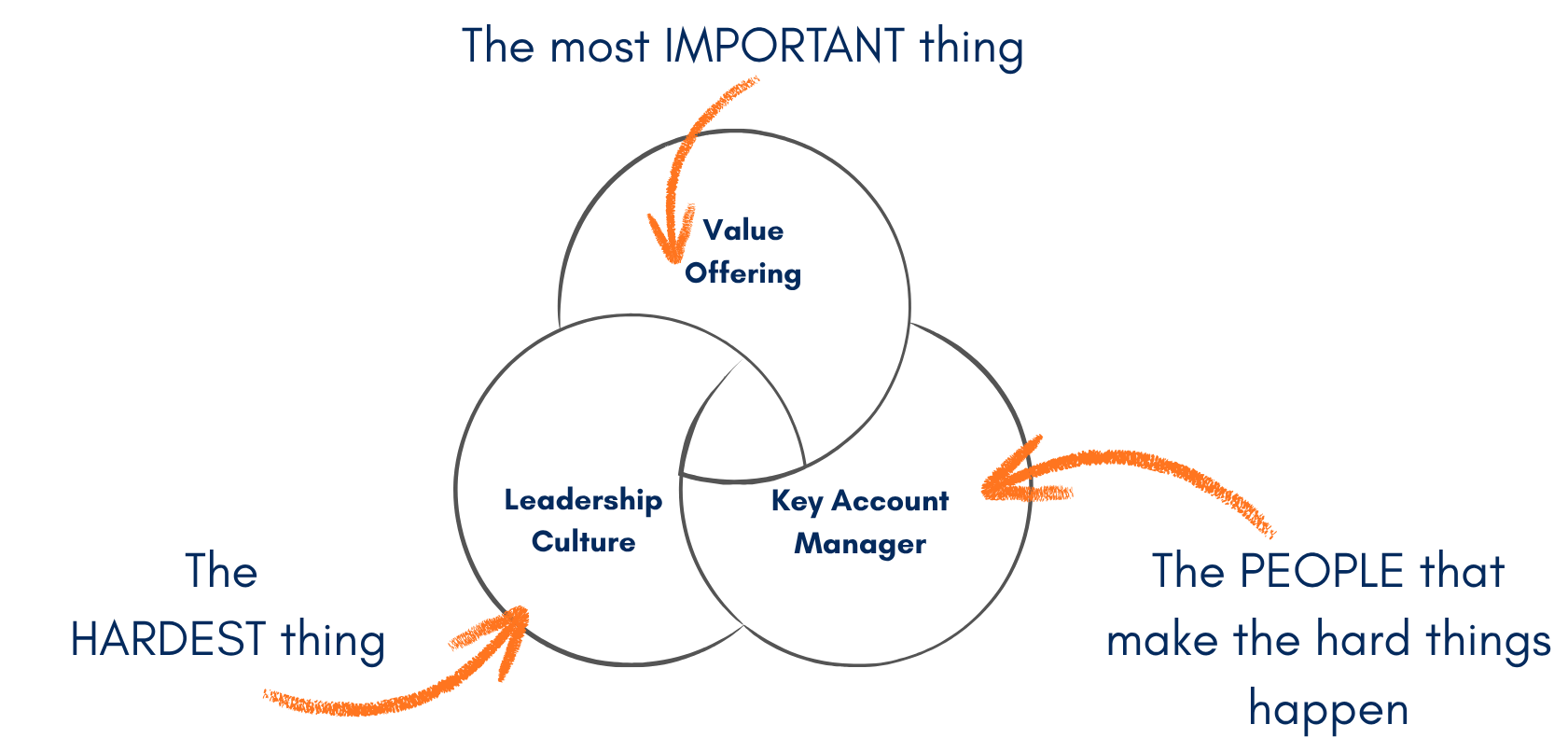
The Most Important Thing: The Customer Value Offering
The People Who Make Hard Things Happen: The Key Account Managers
The Hardest Thing: Leadership that understands and establishes a culture to let KA Managers thrive
Miss any one of these three, and your KAM programme becomes an expensive exercise in relationship management that doesn't move the needle. Get all three right, and you create competitive advantages that are genuinely hard to replicate.
I think we should explore each one.
1. The Customer Value Offering
Most organisations think they're doing Key Account Management when they're really just doing glorified account management with better CRM software.
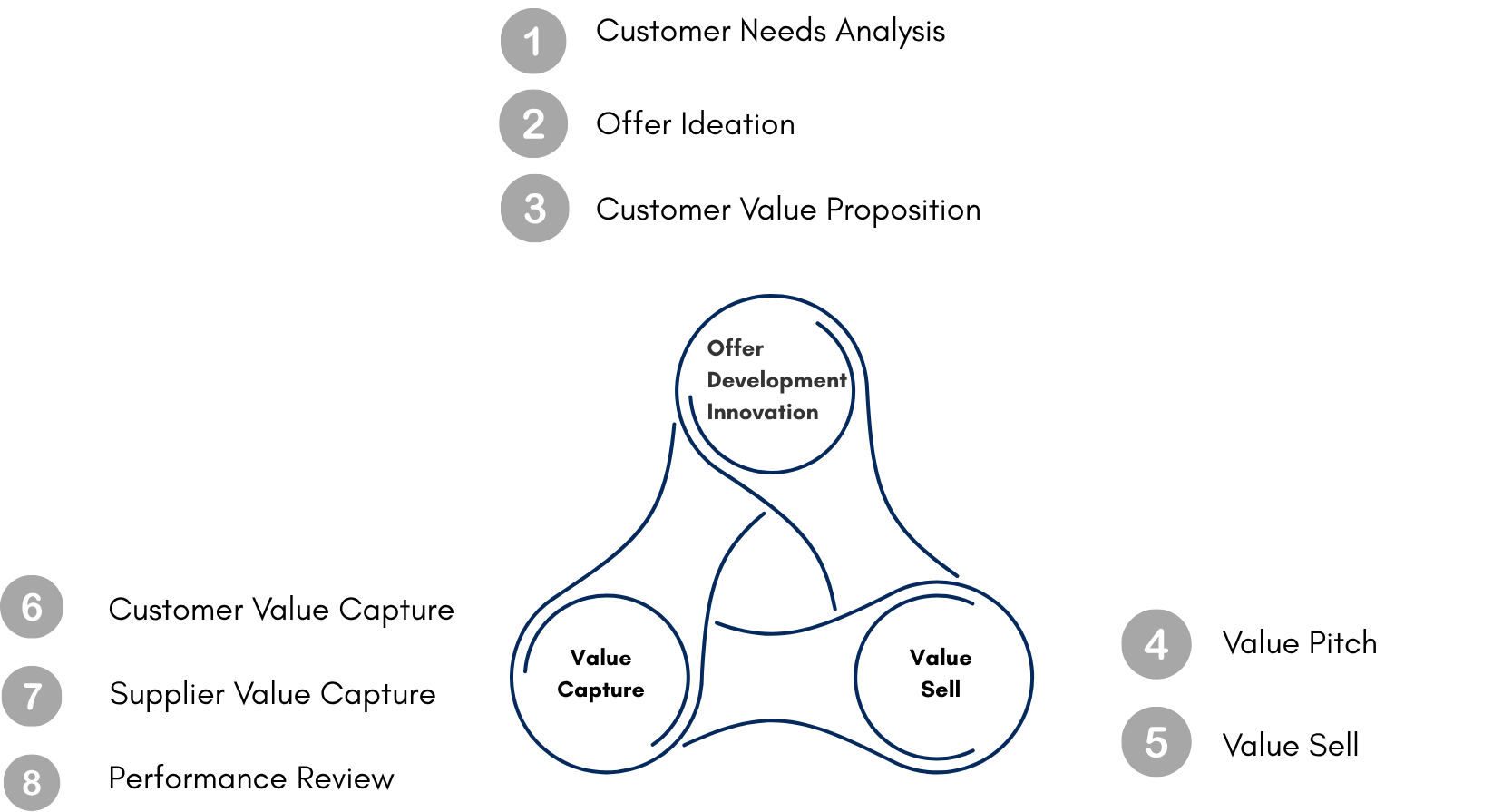
Real Value-Based KAM starts with a fundamentally different question. Not "How do we sell more to this customer?" but "How do we create unique value that moves this customer from their current state to a higher-value future state?"
Traditional KAM follows a predictable pattern. Analyse the customer. Build a relationship. Identify opportunities. Present solutions. Close deals. Repeat. It's logical, structured, and completely insufficient for strategic accounts.

Value-Based KAM operates differently. It starts with deep curiosity about the customer's existing reality, by understanding their strategic context, competitive pressures, and internal challenges. Then it frames these as clear problem statements that matter to the people who control budgets.
From there, you develop an offer that describes precisely how you'll help them get from where they are to where they need to be. Not your product portfolio dressed up in customer language. An actual offer that creates measurable value.
Think of it as Offer Development and Innovation (ODI).
It's the first and most critical phase of the Value-Based KAM Framework, and it's where most organisations stumble.
Why? Because creating genuine offers requires strategic thinking, innovation, and the courage to say "our standard solution won't work here.. actually, we need to create something different."
Too many suppliers fall into "the product trap." They ask, "How can we position our existing offerings for this key account?" Value-Based KAM flips this: "What does this customer actually need to succeed, and how can we uniquely provide that?"
The final step is crystallising your work into a customer value proposition that's clear and convincing. If you can't explain your unique value in two sentences, you don't understand it well enough to sell it effectively to multiple stakeholders.
Here's why this matters: Get ODI right, and everything else becomes easier. You're selling something the customer actually values. Your price becomes less relevant. Competitors struggle to replicate your bespoke approach.
Rush through ODI or treat it superficially, and you'll end up with a beautifully crafted account plan for selling products the customer doesn't really want, at prices they don't want to pay, competing against alternatives that look just like yours.
Creating real value offerings takes time, requires internal collaboration, and demands that you occasionally tell senior leadership, "We can't just push our standard products here."
Most organisations aren't willing to do that work. Which is precisely why those who do gain advantages their competitors can't match.
2. The Key Account Manager (The People That Get Things Done!)
Let's be honest about what we're asking Key Account Managers to do.
We want them to think like strategists, sell like rainmakers, innovate like entrepreneurs, and manage like general managers. We want them to build relationships across organisational boundaries, influence without authority, and deliver results that matter to people they've never met.
Then we act surprised when traditional salespeople struggle with the role.
The truth is uncomfortable but unavoidable: Key Account Managers are not salespeople with bigger territories. They're hybrid professionals who need to operate at a fundamentally different level.
Value-Based KAM requires eight core competencies that look nothing like a traditional sales role:

The Strategic Quartet:
- Strategist: Thinking at the system level, seeing patterns others miss
- Value-Ambassador: Creating value across multiple stakeholders
- Innovator: Developing new solutions for unique challenges
- Change Agent: Managing organisational transformation
The Operational Quartet:
- Rain Maker: Converting opportunities into profitable revenue
- Silo-Buster: Working across departmental boundaries
- Team Builder: Leading without formal authority
- Planner: Managing complexity across long sales cycles
Look at this skill stack and you'll notice something: these aren't sales skills. These are general management skills.
A Key Account Manager is essentially running a business within a business. They're responsible for strategy, operations, innovation, and results. They need to think like owners, not employees.
This creates both opportunity and challenge. The opportunity? Successful KAMs develop incredibly valuable, transferable skills. Many go on to senior management roles because they've learned to operate at that level.
The challenge? Recruitment and development. You can't just promote your best transactional salesperson and expect success.
Here's what works better: Start with your best relationship builders and business developers, then systematically develop their strategic thinking, innovation capabilities, and change management skills. It's easier to teach a great salesperson to think strategically than to teach a strategist to build customer relationships.
The key is recognition. You're not developing salespeople. You're developing business leaders who happen to focus on key customer relationships. This changes everything about how you recruit, train, measure, and reward these critical roles.
But here's the catch: even the most talented Key Account Manager will fail if they're working in the wrong organisational culture.
3. LEADERSHIP & CULTURE:
Many senior executives don't grasp this: Key Account Management programmes fail because of leadership, not execution.
I've seen brilliant KAM strategies sabotaged by leaders who said they wanted customer focus but rewarded product push. I've watched talented Key Account Managers burn out while trying to implement a new way of working in an old-thinking organisation.
The problem isn't usually the strategy or the people. It's the culture.
Value-Based KAM requires fundamental shifts that challenge traditional thinking. Instead of pushing products to markets, you're creating solutions for specific customers. Instead of maximising short-term revenue, you're investing in long-term relationships. Instead of competing on features and price, you're competing on value and insight.
These shifts require courage from leadership. The courage to say no to profitable opportunities that don't align with key customer strategies. The courage to invest in bespoke solutions that don't scale. The courage to measure success differently.
Leadership and Culture operate at two distinct levels:
Strategic Leadership: Senior executives establish the vision, set objectives, and create organisational conditions for success. They define "the way we do things around here."
Operational Leadership: Line managers provide day-to-day coaching, remove obstacles, and maintain focus on embedding value-based approaches.
Both levels are essential. Miss either one and the whole system fails.
The work breaks down into four pillars:
Customer Management Strategy: Not vague "customer-centricity," but a clear roadmap that commits the organisation to delivering genuine value to chosen customers, even when it's difficult or expensive.
Value-Centricity: Going beyond customer focus to value creation across the entire ecosystem—working collaboratively with suppliers, partners, even competitors when it serves the customer's interests.
Structure & Standards: Translating principles into practical operating procedures. How do we make decisions? Allocate resources? Measure success? Handle conflicts between Key Account needs and standard procedures?
Coaching & Alignment: Daily work ensuring all functions understand and support the Key Account approach. Marketing, operations, finance, and customer service all need to think differently about key accounts.
Most KAM programmes fail not because the methodology is wrong, but because leaders underestimate the cultural transformation required. They want the benefits of strategic customer relationships without changing how the organisation actually works.
Here's the paradox: the very difficulty of implementing Value-Based KAM is what makes it such a decisive competitive advantage. Because it's hard, because it requires sustained commitment and cultural change, and most organisations give up or settle for KAM-lite.
Those who persist create something genuinely difficult to replicate. They don't just win customers, they build customer relationships that competitors can't touch.
But it starts with leadership having the patience and conviction to build something that matters.
The bottom line...
Value-Based KAM isn't just an evolution of traditional account management. It's a fundamentally different way of thinking about customer relationships, value creation, and competitive advantage.
It requires three things working in concert:
- The Customer Value Offering: Real, innovative solutions that move customers from their current state to a higher-value future state
- The Key Account Manager: People with the strategic and operational skills to make difficult things happen
- Leadership & Culture: An organisational environment that supports and enables Value-Based KAM
Miss any one of these three elements, and you're left with expensive relationship management that doesn't move the needle. Get all three right, and you build competitive advantages that are genuinely hard to replicate.
The question isn't whether Value-Based KAM works. The question is whether you're prepared to do what it takes to make it work.
Which brings us to the real test...Those 20 Questions.

20 QUESTIONS: Is Your KAM Programme Good Enough?
Now for the real test. These 20 questions will quickly reveal where your KAM programme truly stands. Be honest with yourself—this isn't about what you aspire to do, but what you actually do consistently.
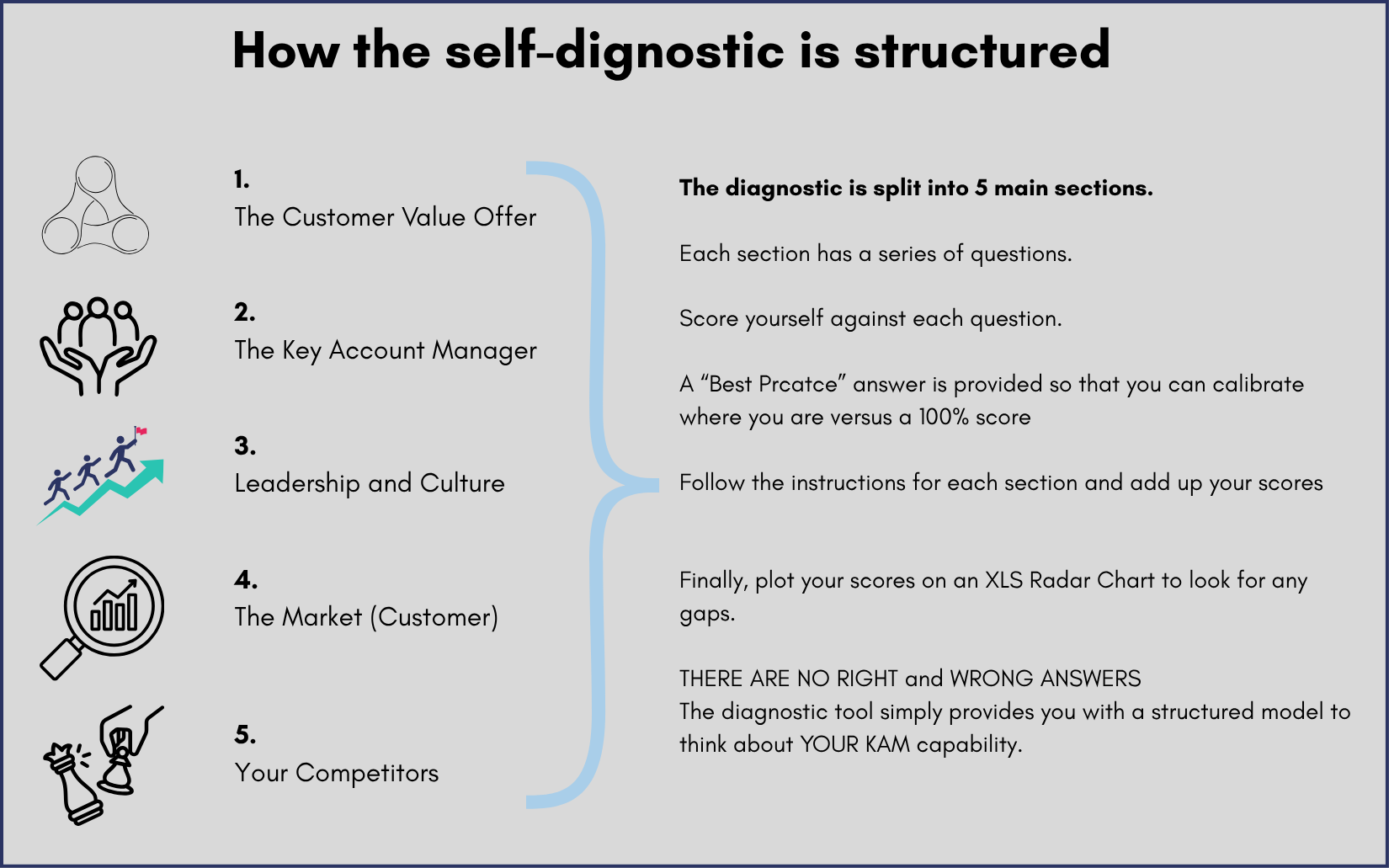
How to Score:
- Rate each question on a scale of 0-10
- 0-3 = Not happening or rarely happening
- 4-6 = Inconsistent or partially implemented
- 7-9 = Consistently happening but room for improvement
- 10 = Best-in-class performance
Each section scores out of 50 points. Total possible score: 250 points.
SECTION 1: THE CUSTOMER VALUE OFFER (50 points)
Q1: Do you have a strategic understanding of each key customer? (10 points)
Best-in-Class (10/10): You have documented strategic profiles for each key customer that include their business model, competitive position, strategic priorities, internal challenges, and decision-making structure. These profiles are updated quarterly through structured conversations with senior stakeholders and inform all offer development. Your KAMs can articulate not just what the customer buys, but why they buy it and how it fits their strategic objectives.
Your Score: ___/10
Q2: Do you create unique customer offer for each key customer? (10 points)
Best-in-Class (10/10): Each key customer receives a bespoke value proposition developed specifically for their situation. You don't present your standard product portfolio; you design solutions that address their unique challenges and opportunities. These offers combine your products/services in novel ways, often involving innovation or customisation that isn't available to regular customers. Your approach is documented in a formal ODI (Offer Development & Innovation) process.
Your Score: ___/10
Q3: Do your customer offers clearly describe the value your customer will receive? (10 points)
Best-in-Class (10/10): Every offer includes a clear value proposition that articulates the measurable business outcomes the customer will achieve. You can explain in two sentences what unique value you deliver and why they should choose you. Your offers specify both tangible metrics (cost savings, revenue growth, efficiency gains) and intangible benefits (risk reduction, strategic positioning) in language that resonates with C-level executives, not just procurement.
Your Score: ___/10
Q4: Are you able to avoid winning business by dropping your price/fee? (10 points)
Best-in-Class (10/10): You compete on value, not price. While price discussions happen, you rarely need discounting to win or retain key account business. When customers request lower prices, you're able to reframe the conversation around value delivered. Your win rate on value-based proposals (without significant discounting) exceeds 70%. You have clear pricing policies that protect margins while demonstrating ROI.
Your Score: ___/10
Q5: Do your customers regard your offer/product/service as the best in your category? (10 points)
Best-in-Class (10/10): Customer feedback and third-party assessments consistently place you at the top of your category for key accounts. Customers describe your offerings as "best-in-class" or "market-leading" unprompted. Your Net Promoter Score for key accounts exceeds +50. When key customers evaluate alternatives, they use you as the benchmark against which others are measured.
Your Score: ___/10
SECTION 1 TOTAL: ___/50
SECTION 2: THE KEY ACCOUNT MANAGER (50 points)
Q6: Have you selected Key Account Managers with a clearly defined set of skills and competencies? (10 points)
Best-in-Class (10/10): You have a documented competency framework covering the 8 core KAM competencies (Strategist, Value-Ambassador, Innovator, Change Agent, Rain Maker, Silo-Buster, Team Builder, Planner). All KAM appointments are made against this framework using structured assessment. You don't simply promote top salespeople; you select or develop individuals who demonstrate strategic thinking, business acumen, and cross-functional leadership ability.
Your Score: ___/10
Q7: Do you have a structured Value-Based KAM training programme in place? (10 points)
Best-in-Class (10/10): You have a comprehensive KAM development programme that goes beyond basic sales training to include strategic account planning, value proposition design, financial analysis, change management, and executive communication. New KAMs complete a structured onboarding programme (3-6 months). Ongoing development includes workshops, coaching, and peer learning. Training is linked to the competency framework and includes clear progression pathways.
Your Score: ___/10
Q8: Do the line managers of every Key Account Manager coach them to perform better? (10 points)
Best-in-Class (10/10): Every KAM has weekly or fortnightly coaching sessions with their line manager focused on account strategy, not just pipeline reviews. Line managers are trained in coaching methodologies and use structured frameworks. These sessions focus on capability development, strategic thinking, and removing obstacles. Managers spend at least 20% of their time in coaching mode and accompany KAMs on critical customer meetings for real-time development.
Your Score: ___/10
Q9: Do you ensure that KAM team members from all functions are trained and developed? (10 points)
Best-in-Class (10/10): Your KAM programme develops the entire extended team, not just the account managers. People from operations, finance, marketing, technical support, and other functions who support key accounts receive training on value-based principles, customer-centricity, and their role in account success. Cross-functional teams have regular knowledge-sharing sessions. Everyone supporting key accounts understands why these customers are different.
Your Score: ___/10
Q10: Do your Key Account Managers speak with senior leaders in your organisation and the customer organisation regularly and with confidence? (10 points)
Best-in-Class (10/10): Your KAMs have regular (at least quarterly) conversations with C-level executives on both sides. They're comfortable discussing business strategy, not just products and services. They can present to the board, articulate strategic recommendations, and influence senior decision-makers. They're seen as trusted advisors by customer executives and as strategic assets by your own leadership team.
Your Score: ___/10
SECTION 2 TOTAL: ___/50
SECTION 3: LEADERSHIP & CULTURE (50 points)
Q11: Have leadership developed and implemented a clear customer selection (segmentation) model? (10 points)
Best-in-Class (10/10): You have a documented, rigorous model for selecting key accounts based on strategic value (not just revenue). The model considers both current business and future potential, mutual value creation opportunity, strategic fit, and profitability. Leadership reviews and updates the key account portfolio annually. You're willing to de-select accounts that don't meet criteria. The model is understood across the organisation and drives resource allocation.
Your Score: ___/10
Q12: Is there a clear strategy and business model detailing how each customer type should be managed? (10 points)
Best-in-Class (10/10): You have documented strategies for different tiers of customers (key accounts, major accounts, standard accounts) that define service levels, resource allocation, and engagement models. For key accounts specifically, you have a clear Value-Based KAM business model covering the framework (ODI, Value Sell, Value Capture), required competencies, and cultural elements. These aren't just PowerPoint decks. They're operational realities.
Your Score: ___/10
Q13: Have leadership set out a series of standards that define how key accounts will be managed? (10 points)
Best-in-Class (10/10): You have clear, documented standards covering account planning cadence, executive engagement requirements, value capture processes, reporting structures, and decision-making authority. KAMs know what's expected, what resources they can access, and when they need leadership involvement. Standards include quality thresholds for account plans, frequency of customer reviews, and escalation protocols. These standards are monitored and enforced.
Your Score: ___/10
Q14: Do leadership teams regularly listen to each Key Account Team presenting their growth strategies for each customer? (10 points)
Best-in-Class (10/10): Senior leadership conducts formal quarterly business reviews with each key account team. These are strategic discussions, not pipeline reviews. KAMs present account strategies, value creation opportunities, challenges, and resource needs. Leadership provides strategic guidance, removes obstacles, and commits resources. These sessions are calendar-protected and rarely rescheduled. Decisions are documented and followed up.
Your Score: ___/10
Q15: Has a culture of customer-centricity and value-based business been established across the company? (10 points)
Best-in-Class (10/10): Value-based, customer-centric thinking permeates the organisation. Employees in all functions understand their role in creating customer value. Reward systems recognise value creation, not just revenue. When a key account needs conflict with standard procedures, there are transparent processes for exceptions. Cross-functional teams willingly support key account initiatives. Customer success stories are regularly celebrated. You measure and track cultural indicators.
Your Score: ___/10
SECTION 3 TOTAL: ___/50
SECTION 4: COMPETITOR ABILITY (50 points)
Q16: Is there effort and focus to understand the approach that competitors take in managing key customers? (15 points)
Best-in-Class (15/15): You have systematic competitive intelligence processes that track how competitors approach key account management. You know which competitors have formal KAM programmes, how they're structured, what value propositions they use, and where they're investing. This intelligence is gathered through customer conversations, market research, and industry networking. Insights are shared regularly with KAMs and inform strategy. You benchmark your KAM capability against best-in-class competitors.
Your Score: ___/15
Q17: Are you better than your main competitors at KAM? (20 points)
Best-in-Class (20/20): You have objective evidence that your KAM capability exceeds competitors. Customer feedback consistently indicates you provide superior strategic support, value creation, and partnership. Your win rates in competitive key account situations exceed 65%. When you lose, you understand why and learn from it. Independent assessments (customer surveys, win/loss analysis, market research) confirm you're in the top quartile of your industry for KAM effectiveness.
Your Score: ___/20
Q18: Do you seek the opinion of your customer regarding how you perform compared to your competitors? (15 points)
Best-in-Class (15/15): You conduct formal voice-of-customer research with key accounts at least annually that includes competitive comparisons. You ask specific questions about how your value proposition, account management, innovation, and partnership compare to alternatives. You're willing to hear uncomfortable truths. Results are shared with account teams and leadership, driving improvement initiatives. You track changes in competitive perception over time. Customers see you as genuinely interested in improvement, not just fishing for compliments.
Your Score: ___/15
SECTION 4 TOTAL: ___/50
SECTION 5: MARKET NEEDS (50 points)
Q19: Have you assessed whether your key customers require strategic support from suppliers in your category? (25 points)
Best-in-Class (25/25): You've conducted thorough research to understand whether key customers in your category genuinely need strategic partnerships versus transactional relationships. You know which customer segments value strategic supplier relationships and which prefer arms-length procurement. This assessment drives your KAM strategy, and you're not trying to be strategic with customers who don't want or need it. You understand your customers' procurement maturity, their appetite for collaboration, and their capacity to engage in value-based relationships.
Your Score: ___/25
Q20: Do you gather feedback from key customers regarding your performance as a trusted supplier? (25 points)
Best-in-Class (25/25): You have formal mechanisms for gathering structured feedback from key customers on trust, performance, and partnership quality. This goes beyond satisfaction surveys to include relationship health metrics, trust indicators, and value realisation assessments. You measure both transactional performance (delivery, quality, responsiveness) and strategic partnership value (innovation, insight, collaboration). Feedback is gathered at multiple levels (operational and executive) and includes both quantitative and qualitative elements. Results drive continuous improvement and are visible to leadership.
Your Score: ___/25
SECTION 5 TOTAL: ___/50
YOUR TOTAL SCORE: ___/250
INTERPRETING YOUR SCORE:
200-250: World-Class KAM Programme You have a mature, well-functioning Value-Based KAM capability. Focus on continuous improvement and maintaining excellence as the market evolves.
150-199: Strong Foundation with Growth Opportunities You have good fundamentals in place but significant opportunities to elevate performance. Identify the lowest-scoring sections and develop targeted improvement plans.
100-149: Developing Capability Your KAM programme exists but isn't yet delivering its full potential. You likely have gaps in one or more of the three critical elements (Offer, People, Culture). Prioritise systemic improvements over tactical fixes.
50-99: Early Stage or Struggling Your KAM programme needs significant development. Consider whether you have genuine leadership commitment to Value-Based KAM or if you're doing "KAM-lite." Focus on building foundational elements before expanding scope.
0-49: Fundamental Rethink Required You may not have a functioning KAM programme, or what you have bears little resemblance to Value-Based KAM. Consider starting with a clear strategy for whether and how to implement genuine KAM capability.

You can plot your scores on an XLS radar chart
REVIEWING YOUR SCORES:
Look at your section scores. Where are the most significant gaps?
- If Section 1 (Customer Value Offer) is lowest: Focus on ODI processes, customer understanding, and value proposition development
- If Section 2 (Key Account Manager) is lowest: Invest in talent selection, competency development, and coaching capability
- If Section 3 (Leadership & Culture) is lowest: This is often the root cause—address cultural and structural issues before expecting execution improvements
- If Section 4 (Competitor Ability) is lowest: Strengthen competitive intelligence and differentiation strategies
- If Section 5 (Market Needs) is lowest: Ensure you're solving the right problem—do customers actually need strategic KAM?
Remember: Value-Based KAM requires all three elements working together. Don't just fix the lowest score, ensure you have strength across all dimensions.
What next?
We would like to know how you have used this self-diagnostic tool. Let us know my emailing your comments:
[email protected]
Enrol in our new Value-Based KAM + AI Training Course!
If you are interested in attending a cohort training programme for Key Account Managers and sales leaders, drop us a line! We will be happy to explain how the course works and what you might expect.

Follow Mark Davies and Richard Brooks on LinkedIn for updates over the coming weeks.

Responses