
INTRODUCTION
Last year, I worked with a manufacturing company that had just promoted its star salesperson (let’s call her Joan) to Key Account Manager. Joan was brilliant. She consistently hit 130% of quota, customers loved her, and she had a gift for closing deals that made the rest of the team look like amateurs.
But six months into her new role, Joan was miserable. Her key accounts were stagnating. Internal stakeholders were frustrated. And Joan, for the first time in her career, was failing.
What happened?
The company made the classic mistake: they assumed that being great at foundation-level sales meant she'd be great at Key Account Management. And Joan is not an isolated case…I have seen this story roll out many times.
They promoted a sprinter and asked her to run a marathon. Or more accurately, they promoted a sprinter and asked her to coach a team, design the training program, and manage the logistics of a multi-year expedition.
Same sport...but a very different game.
Key account Managers are different
Here's what we're asking Key Account Managers to do, and let's be brutally honest about it:
We want them to think like strategists, seeing patterns and connections across complex systems and understanding how their customers' business really works at a fundamental level.
We want them to sell like rainmakers, converting opportunities into profitable revenue while navigating increasingly sophisticated buying committees.
We want them to innovate like entrepreneurs, developing new solutions and approaches for challenges that don't have playbook answers.
We want them to manage like general managers, coordinating resources, leading teams, and delivering results across multiple departments they don't control.
Then (and this is where it gets really interesting) we want them to build relationships across organisational boundaries, influence people who don't report to them, and deliver value to stakeholders they've never met.
Oh, and we'd like all this to show up in profitable revenue growth, customer retention, and strategic competitive advantage.
We want them to follow a Value-Based KAM framework that is challenging, stretching and has a lot of moving parts. It’s a tough ask for anybody!
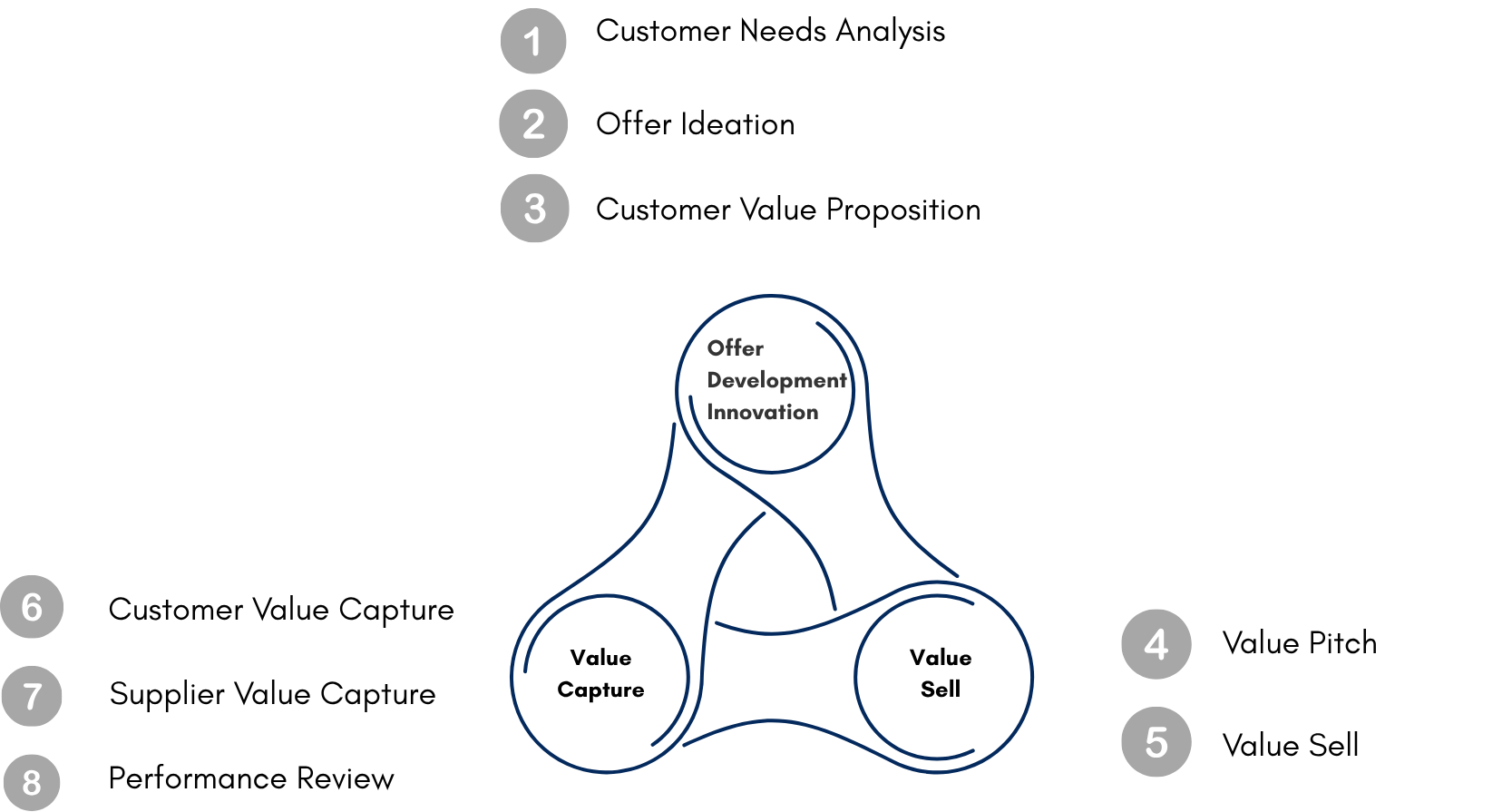
The Value-Based KAM Framework (Davies)
No pressure,eh?!
Then we act genuinely surprised when traditional salespeople struggle with the role. We shake our heads, wondering why they can't "step up" or "think strategically." We bring in consultants. We create more elaborate planning templates. We send them to leadership development programs.
And we still miss the fundamental point: Key Account Managers are not salespeople with bigger territories.
They're hybrid professionals who need to operate at a fundamentally different level. The sooner we acknowledge this, the sooner we can build KAM programmes that actually work.
The 8 core competences
(And why they're not just glorified selling skills..)
Over two decades of working with Key Account Managers across dozens of industries, I've identified eight core competencies that separate successful KAMs from those who struggle. They fall into two categories:
Strategic and Operational.

Source: Infinite Value - Davies / Bloomsbury Publishing
The Strategic Quartet
Strategist: This isn't about knowing your product line. It's about thinking at the system level…understanding how your customer's business operates, where their industry is heading, and how the pieces fit together. It's pattern recognition. It's connecting dots that others don't see. When a strategist looks at a customer, they don't see a sales opportunity; they see a complex adaptive system with challenges, constraints, and possibilities.
Value-Ambassador: This one's subtle but crucial. A Value-Ambassador represents and creates value across multiple stakeholders; not just their own company's value proposition, but genuine business value for different people with different priorities. They translate between worlds. They can explain to the customer's CFO why this matters financially, to the operations team why it matters practically, and to the CEO why it matters strategically. Same solution, completely different conversations.
Innovator: Key accounts don't respond to standard offers. By definition, if you're treating them like regular customers, you're doing KAM wrong. Innovators develop new solutions and approaches for unique challenges. They're comfortable with ambiguity. They can say, "We've never done this before, but here's how we could make it work." The “catalogue” does not bind them.
Change Agent: Here's something most KAM training misses entirely: half your job is managing change inside your own organisation (and change in your customer operations as they adopt new solutions). You're constantly asking colleagues to do things differently, bend processes, or allocate resources in new ways. Understanding and managing organisational transformation isn't a nice-to-have skill; it's a survival skill. Change Agents know how to build coalitions, manage resistance, and make things happen without formal authority.
The Operational Quartet
Rain Maker: Yes, you still need to sell. But Rain Makers don't just close deals, they convert complex opportunities into profitable revenue over extended timeframes. They're orchestrating multi-threaded sales processes across buying committees they might not even fully see. They maintain momentum through long sales cycles. They know when to push and when to wait. This isn't transactional selling; it's strategic revenue generation.
Silo-Buster: Show me a KAM program that works, and I'll show you Key Account Managers who can work effectively across departmental boundaries. Silo-Busters get things done in matrix organisations. They build bridges between departments that rarely communicate with each other. They translate between different languages (engineering speaks differently than finance speaks differently than operations). They make cross-functional collaboration look easy, even though it's anything but.
Team Builder: Here's the rub: Key Account Managers lead teams they don't manage. You're coordinating people from different departments who report to other managers, have different priorities, and might not even agree that this key account deserves special treatment. Team Builders lead without formal authority. They create clarity, build trust, and maintain alignment across people who have every reason to focus on something else.
Planner: With everything else going on, you still need to manage complexity and coordinate multiple moving parts. Planners don't just make plans (anyone can fill out a template). They maintain strategic coherence across dozens of initiatives, hundreds of interactions, and constantly shifting priorities. They know what matters now versus what matters next quarter. They can zoom in and zoom out. They keep all the plates spinning without looking frantic.
Why this list should make you uncomfortable
Look at those eight competencies again.
Notice anything?
These skills are not typically associated with traditional sales roles. They belong to general management.
And that's exactly the point.
A Key Account Manager is essentially running a business within a business. They're responsible for strategy, operations, innovation, and results across a portfolio that might represent millions (or tens of millions) in revenue. They need to think like owners, not employees.
This creates both a massive opportunity and a significant challenge.
The opportunity? Successful KAMs develop incredibly valuable, transferable skills. I've watched dozens of Key Account Managers transition into senior management roles, such as VP of Sales, COO, and even CEO positions. All because they learned to operate at that level. KAM is a genuine leadership development program disguised as a sales role.
The challenge? Recruitment and development become exponentially more difficult. You can't just promote your best transactional salesperson and expect success. The skills are different. The mindset is different. The measures of success are different. The entire operating system is different.
The foundation layer (skills a KAMgr builds on)
Underneath these eight core competencies sits a foundation of traditional business skills that somehow gets overlooked: financial analysis, negotiation, presentation skills, project management, and business acumen.
These aren't optional extras or nice-to-haves. They're entry requirements.
However, what's interesting is that many traditional salespeople already possess these skills, or have the raw capability to develop them quickly. They've just never been asked to apply them at this level of complexity and strategic importance.
I've seen salespeople who can read a balance sheet but have never had to.
Who can manage complex projects but have never needed to.
Who can present to C-level executives but have only pitched to procurement.
The capability is there. It's just dormant.
This is actually encouraging because it means we're not starting from zero. We're elevating existing capabilities to a new context.
Of course, negotiation, communication, resilience and an unwavering desire to understand problems are also foundation skills. You would expect these for any effective sales / account manager.
A development tension
Here's where most organisations go wrong.
They look outside for KAM talent, assuming they need to hire general managers and teach them to sell. I've seen this play out dozens of times, and it rarely works.
Why? Because general managers, no matter how smart or experienced, typically don't have the relationship-building instincts, customer empathy, or commercial drive that make great Key Account Managers. You can teach strategic thinking. It's much harder to teach genuine customer focus and the ability to build deep, trust-based relationships.
Salespeople can make exceptional Key Account Managers... but they need help, guidance, training and support to make that transition.
The better approach (though it requires more investment & patience) is to start with your best relationship builders and business developers, then systematically develop their strategic thinking, innovation capabilities, and change management skills.
It's easier to teach a great salesperson to think strategically than to teach a strategist to build customer relationships.
But let's be clear: this isn't a six-month development program. We're talking about a multi-year journey. You're not just teaching new skills; you're transforming how someone thinks about their role, their customers, and their contribution to the business.
What this might mean for you
If you're a Key Account Manager reading this, you might be feeling either validated or overwhelmed (possibly both).
Validated because someone finally acknowledged that what you're doing is legitimately difficult and requires skills far beyond traditional selling.
Overwhelmed because, well, look at that list. Eight core competencies plus a foundation layer of business skills? Who has all of those?
Here's the good news: you don't need to be world-class at all eight competencies simultaneously. But you do need to be competent in all of them and excellent in at least a few.
Think of it as a development roadmap. Where are you strongest? Where are your gaps? Which competencies matter most for your current key accounts?
Then build deliberately. One competency at a time. One year at a time.
If you're a Sales Director or CRO, this list should change how you think about three critical areas:
Recruitment: Stop hiring for KAM roles the way you hire for sales roles. You're looking for different capabilities. Consider internal candidates from other functions, such as project managers, business analysts, and product managers; individuals who possess customer instincts and a commercial drive. The strategic and operational skills might be easier to find than you think once you look beyond traditional salespeople.
Development: Systematic capability building isn't optional anymore. You need structured programs that develop these eight competencies over time. Think leadership development, not sales training. Think MBA curriculum, not sales methodology.
Measurement: If you're only measuring revenue and margin, you're missing most of what creates value in Key Account Management. Strategic impact, customer satisfaction, innovation, cross-functional collaboration…. these matter as much as the numbers on your P&L.
The important shift in thinking
Here's the shift that makes everything else possible:
You're not developing salespeople. You're developing business leaders who happen to focus on key customer relationships.
Let that sink in for a moment.
This changes everything about how you recruit, train, measure, and reward these critical roles.
It changes the career path (these folks should be on a leadership track, not a sales track).
It changes compensation (you're paying for strategic impact, not just revenue generation).
It changes support (they need executive-level resources and access, not sales manager oversight).
It changes expectations (you're looking for business outcomes, not activity metrics).
Most importantly, it changes respect. Key Account Managers aren't "just salespeople." They're hybrid professionals operating at the intersection of strategy, operations, and customer relationships, and arguably one of the most complex roles in modern business.
But what about poor Joan?
Joan, the star salesperson I mentioned at the beginning? Here's how her story ended.
After six months of struggle, her company finally recognised the problem wasn't Sarah.
The problem was that they'd never equipped her for the role she was actually being asked to do. They brought in coaching focused specifically on strategic thinking and change management (her two biggest gaps). They adjusted her metrics to reflect strategic impact, not just quarterly revenue. They gave her air cover to experiment and occasionally fail.
Eighteen months later, Sarah isn't just succeeding, she's redefining what's possible with key accounts in her industry. She's developing innovations her competitors can't match. Her strategic accounts are growing at a 30% year-over-year rate. And she's mentoring three other Key Account Managers who are following a similar development path.
Same person. Different context. Completely different outcome.
That's what happens when we finally acknowledge what we're really asking Key Account Managers to do.
Results and performance accelerate when we give them what they actually need to succeed.
What's Next?
What's your experience? Are you developing salespeople or business leaders? Hit reply and let me know. I read every response.
Thanks for reading!
Mark Davies
If you're interested in coaching and training on Value-Based KAM and Offer Development & Innovation for your team, visit our website and get in touch!
 |


Responses