
(It always did)
Professional selling is not dying
(But the version most firms invest in needs to evolve)
Let me start with a confession.
I have spent the last couple of years adding my voice to a growing chorus: that AI and technology are squeezing the life out of traditional selling. That the days of the relationship-driven, persuasion-led, phone-in-hand salesperson were numbered.
I was wrong. Or at least, I was telling only half the story.
Yes, AI is transforming B2B selling at a pace. Yes, the traditional model of product-feature selling, quarterly business reviews and information-advantage tactics is being dismantled. I made that case in my previous value-matters newsletters, and I stand by it.
But here is what I missed — and what most organisations are missing right now.
What is dying is transactional selling. The reordering of standard products. The renewal of routine contracts. The processing of repeat business. These interactions are rapidly migrating to online platforms and machine-to-machine transactions, where AI-driven procurement systems communicate directly with AI-driven supply systems, and humans are simply not part of the loop. In many B2B categories, this is already the reality. In most, it will be within a decade.
For organisations still relying on human resources to manage high-volume, low-complexity customer interactions, this is a serious structural threat. The economics no longer support it, and competitors who have automated these processes will have meaningful cost advantages that compound over time.
But here is the other side of that equation, and it is just as important.
As transactional selling moves to machines, the interactions that remain for skilled humans become, by definition, more valuable. More complex. More consequential. The conversations that cannot be automated are the ones that shape long-term partnerships, resolve difficult situations, unlock new opportunities and build the kind of trust that makes a customer relationship genuinely hard to replicate.
The profession is not shrinking. It is bifurcating.
On one side: automated, efficient, machine-managed transactional exchange. On the other: high-skill, high-stakes, deeply human strategic selling. The middle ground — the comfortable space where many sales organisations currently operate — is the territory under the most pressure, and the one most at risk of being eroded from both directions simultaneously.
McKinsey’s 2024 B2B Pulse Survey, drawing on nearly 4,000 decision-makers across 34 sectors, confirms this picture directly: digital channels are increasingly effective for straightforward customer interactions, while human sellers remain essential for the complex, relationship-dependent exchanges where the real commercial value resides (Plotkin et al., 2024).
This bifurcation is also reshaping supply chains in ways that are only beginning to be understood. As procurement becomes more automated and data-driven, the ability of suppliers to differentiate on price, product specification or delivery terms is diminishing. Procurement AI is increasingly effective at identifying the best available deal on standardised criteria — and at doing so faster, more consistently and at greater scale than any human buyer.
McKinsey estimates that generative AI alone could unlock between $0.8 trillion and $1.2 trillion in incremental productivity across sales and marketing functions globally — a figure that underlines both the scale of the opportunity and the competitive risk for organisations that delay (McKinsey, 2024). Suppliers who compete primarily on transactional terms will find themselves under sustained margin pressure. The advantage shifts — clearly and decisively — to those who can offer something the algorithm cannot evaluate: co-created value, embedded capability, strategic insight, and the kind of trust-based relationship that makes switching suppliers a genuinely costly decision.
Your competitors who understand this are already moving. They are investing not just in AI tools, but in the human capabilities that make those tools meaningful. They are building relationships at levels where strategic decisions are made. They are embedding themselves in their customers’ businesses in ways that create genuine switching costs…not contractual ones, but organisational, relational and cultural ones.
The window to move in this direction is open. But it will not stay open indefinitely.
The evolution of selling, then, is not a retreat from the fundamentals. It is a return to them, executed at a higher level of sophistication, supported by better tools, and focused on the interactions that genuinely move the needle. The foundation skills of great selling do not become irrelevant in this world. They become the entry requirement.
So What Does This Mean For You?
If you are a B2B supplier, whether you lead a sales function, manage a portfolio of key accounts, or run a business that depends on customer relationships, the message is this: your ability to compete will diminish if you do not evolve your commercial capability alongside your technology investment.
The two are not in opposition. They are, in fact, inseparable.
Here is what that evolution looks like in practice.
The Skills Required for the New Economy
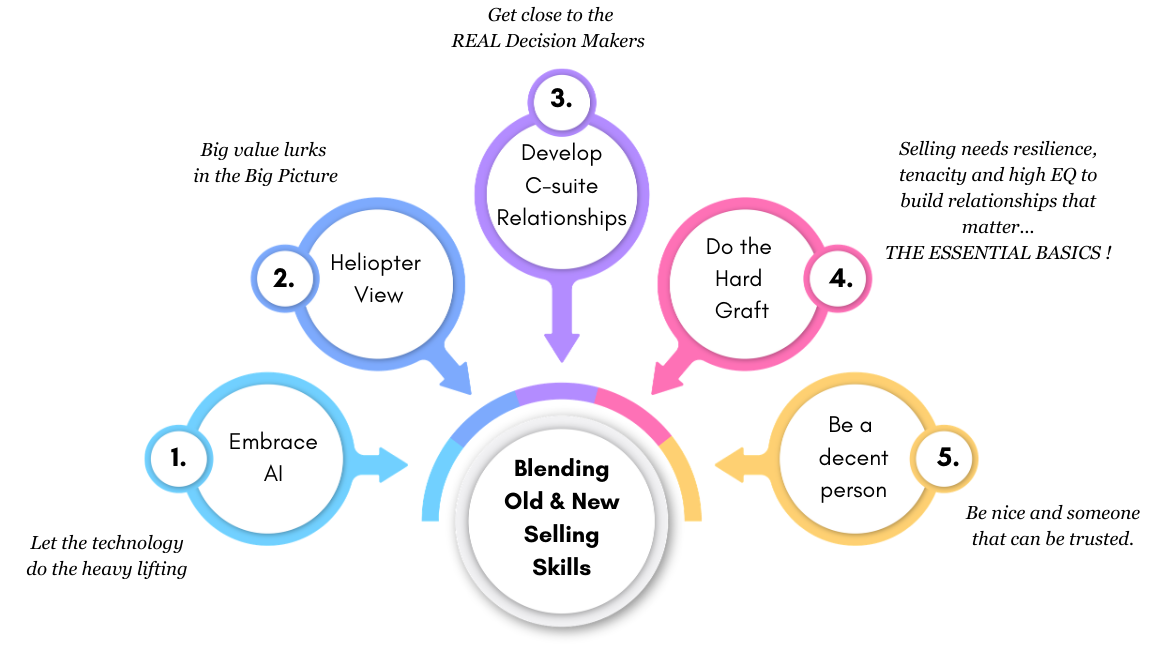
1. Embrace AI (Use it to free yourself up for the things only you can do)
The strategic key account manager who treats AI as a threat has already lost. The one who treats it as a lever has just given themselves a significant advantage.
AI can take a substantial administrative and analytical burden off the shoulders of any good salesperson. In practical terms, that means using it to accelerate customer and market research, to draft and refine value propositions, to prepare for meetings with detailed stakeholder briefings, to analyse CRM data for patterns and early warning signals, to generate multiple commercial scenarios quickly, to monitor competitor and customer news in real time, and to follow up meetings with structured summaries and action plans.
What this creates is time. Time to think. Time to be present. Time to do the irreducibly human work that no algorithm can replicate.
The question is not whether to use AI. It is whether you are using the time it creates wisely.
2. Take the helicopter view (across the whole value ecosystem)
Traditional selling focused on the customer. Strategic selling focused on the customer and a few key contacts within it. The next evolution goes further.
Today’s most effective key account managers think in ecosystems. They consider not just the customer, but also the suppliers feeding into that customer, the partners and associates surrounding them, the competitors shaping market dynamics, and the broader forces: regulatory, economic, technological, often pressing in from the outside.
This is not new thinking. What is new is that sales professionals are increasingly the people best placed to do it, because they sit at the intersection of more relationships and more real-time market intelligence than almost anyone else in the business.
The KAM who can align the supply chain, spot collaborative opportunities, and bring multiple parties together around a shared value-creation agenda is not just selling. They are becoming indispensable.
3. Build genuine relationships at the C-suite level
This is where the real value opportunities live, and where most commercial relationships remain frustratingly shallow.
Research published in the Harvard Business Review reinforces the point: customer health in B2B relationships is determined not just by satisfaction or contract renewal, but by the depth and quality of the relationship itself , which requires ongoing human investment at senior levels to sustain (Hochstein et al., 2024).
C-suite engagement is not about schmoozing or senior access for its own sake. It is about operating at the level where strategic decisions are made, where value is truly understood, and where the long-term shape of a partnership is defined. That requires credibility, preparation, and the confidence to have an honest conversation about what the customer actually needs, even when the answer is uncomfortable.
It also requires the same investment internally. The KAM who lacks the respect of their own leadership will struggle to represent the customer’s voice where it needs to be heard.
4. Resilience, tenacity, and the willingness to do the hard graft
Selling is one of the most consistently undervalued professions in business. And yet, at its core, it demands something genuinely difficult: the sustained ability to handle rejection, maintain belief, push through resistance, and make things happen in the face of inertia.
That has always been true. What is changing is the stakes.
As routine transactions migrate to automated systems, the interactions that remain for skilled humans are, by definition, the harder ones. The complex deals. The difficult stakeholders. The negotiations have broken down and need to be rebuilt. The conversations where the outcome genuinely matters.
In that environment, the capacity to persist and to pick up the phone after a difficult meeting, to go back to a customer who said no, to maintain momentum through a long and uncertain sales cycle, is not a soft skill. It is a core commercial asset. And it cannot be automated.
5. Just be someone people like
This one is easy to underestimate, and important enough to say plainly.
There is a temptation, particularly in the current moment, to frame the future of KAM entirely in terms of strategy, frameworks and technical capability. And those things matter. But they are not sufficient.
A systematic review of over 100 KAM research papers published across three decades concludes that the capabilities most central to KAM effectiveness, trust, relationship depth, and knowledge integration, are precisely those that are trust-based, value-based, and hardest for competitors to imitate (Sandesh and Paul, 2023). In an AI-accelerated market, that conclusion has never been more commercially relevant. At the end of the day, customers (particularly in times of change and disruption) gravitate towards people they trust, enjoy working with, and believe are genuinely on their side.
Not just professionally competent, but decent. Authentic. Someone who gets things done without creating drama, who delivers on what they promised, and who runs towards a problem rather than away from it when something goes wrong.
Being a reliable pair of hands is not a romantic idea. In complex B2B relationships, where the consequences of failure are serious and the number of moving parts is large, it is one of the most powerful qualities a commercial professional can possess.
You cannot fake it. But you can build it. And no AI will ever replace it.
A Final Word
Professional selling and key account management are evolving. That is not a threat: It is an opportunity.
The foundation skills of great selling, persuasion, resilience, trust, presence, the ability to navigate complexity and make things happen are not becoming less relevant. They are becoming more valuable, precisely because they are the things that technology cannot replicate.
What is changing is the standard expected. The bar is rising. The KAMs and commercial leaders who invest in both new and timeless capabilities will find themselves in a strong and increasingly rare position.
Selling will become one of the most technically demanding and sought-after professions in B2B. Those who master it… the full picture, not just the tools, will do very well for themselves and the organisations that they represent.
The question is whether your firm is training for that future or just for the goods and services you sell today.
A QUICK AND DIRTY DIAGNOSTIC:
WHERE ARE YOUR SELLING SKILLS POSITIONED TODAY?
Are You Selling for the New Economy?
A 10-Question Diagnostic
The newsletter you have just read draws a distinction between two versions of professional selling: the traditional model that is rapidly losing ground, and the evolved, strategically capable version that is becoming more valuable by the year. The diagnostic below is designed to help you place yourself honestly on that spectrum. There are no right answers, only useful ones to help you think and reflect.
Rate each statement from 1 to 5 using the scale below.
1 — Rarely or never true
2 — Occasionally true
3 — Sometimes true
4 — Often true
5 — Consistently and deliberately true
1. I use AI tools regularly to prepare for customer conversations — researching stakeholders, analysing market context, and briefing myself before meetings.
1 = I rely on experience and intuition to prepare / 5 = AI is a standard part of my preparation process
2. I can articulate the specific, measurable value my customer has received from working with me — not just what I sold them, but what changed in their business as a result.
1 = I focus on what I sell, not what happens after / 5 = I track and communicate delivered outcomes as a matter of course
3. I have active relationships with senior leaders — C-suite or equivalent — in my key accounts, built on genuine commercial credibility rather than social familiarity.
1 = My relationships are primarily with buyers and day-to-day contacts / 5 = I operate comfortably and credibly at the most senior levels
4. I think beyond my immediate customer to consider their suppliers, partners and competitive environment when developing my account strategy.
1 = My focus is on the customer organisation itself / 5 = I take a full ecosystem view when planning and creating value
5. When a deal stalls, a customer pushes back, or a relationship becomes difficult, I lean in rather than pull back.
1 = Resistance and rejection tend to slow or stop my momentum / 5 = Persistence under pressure is one of my defining commercial strengths
6. I spend the majority of my customer-facing time on strategic conversations rather than transactional or administrative activity.
1 = Much of my time is spent on tasks that could be automated or delegated / 5 = I consistently protect my time for high-value, human-only interactions
7. I co-create solutions with my customers — developing ideas and approaches that neither organisation could arrive at independently.
1 = I present and adapt existing solutions / 5 = I regularly facilitate joint innovation that genuinely changes what the customer does
8. Customers and colleagues would describe me as someone who is reliable, straightforward and who makes difficult things easier — not harder.
1 = I am not consistently known for this / 5 = This is a core part of how I am perceived and how I behave under pressure
9. I have a clear and honest view of where AI and automation are changing my role — and I am actively evolving my skills and approach in response.
1 = I am largely waiting to see how things develop / 5 = I am proactively shaping my own evolution as the market changes
10. I invest regularly in developing my commercial craft — through reading, reflection, peer learning or formal development — not just product knowledge.
1 = My development focus is primarily on what I sell / 5 = I treat selling itself as a professional discipline, I am continuously improving
Your Score
Where are you?
Add up your ratings across all 10 questions and find your place on the spectrum below.
10 — 25 | The Transactional Seller
Your foundations are in place, but your commercial model is under pressure. You are operating in a world that is moving faster than your current approach can sustain. The good news: the skills you need are learnable, and the shift is less about reinvention than evolution. The starting point is honesty about where your time actually goes and what your customers genuinely value.
26 — 39 | The Evolving Professional
You are in transition — and that is exactly the right place to be. You have solid instincts and some strong capabilities, but there are gaps between how you work now and what the new economy demands. The questions where you scored lowest are your development priorities. Focus there, and you are well placed to move decisively into the top tier.
40 — 50 | The Strategic Value Creator
You are selling at the level the market is moving towards. You combine the foundation skills of great selling with the strategic mindset, human depth and technological fluency that define the evolved professional. The challenge now is consistency — and helping the people around you make the same shift. You may also be underestimating how rare your capabilities are becoming.
Whatever your score, the most important question is not where you are — it is whether you are moving in the right direction.
References & Sources
Gartner (2023) Gartner Expects 60% of Seller Work to Be Executed by Generative AI Technologies Within Five Years. Gartner Newsroom, 21 September 2023.
Gartner (2025) Gartner Says By 2030, that 75% of B2B Buyers Will Prefer Sales Experiences that Prioritise Human Interaction Over AI. Gartner Newsroom, August 2025.
Hochstein, B., Voorhees, C., Johnson, R., McCoy, N. and Mehrotra, V. (2024) ‘Toward Healthier B2B Relationships’, Harvard Business Review, July–August 2024.
McKinsey & Company (2024a) An Unconstrained Future: How Generative AI Could Reshape B2B Sales. McKinsey Quarterly, September 2024.
Plotkin, C.L., Stanley, J., Harrison, L. and García de la Torre, V. (2024) Five Fundamental Truths: How B2B Winners Keep Growing. McKinsey & Company, 12 September 2024.
Sandesh, S.P. and Paul, J. (2023) ‘Key Account Management in B2B Marketing: A Systematic Literature Review and Research Agenda’, Journal of Business Research, 156.
About Mark Davies
Mark is the MD and Founder of Value-Matters. He works with leading B2B organisations on Value-Based KAM and commercial capability development.


Responses