
How 3rd party partnerships form value-cells
INTRODUCTION
Here is a question worth sitting with for a moment.
What percentage of your revenue reaches your target customers directly? And what percentage travels through intermediaries, distributors, contractors, resellers, agents, channel partners of one kind or another?
For most of the senior leaders I work with across B2B sectors, that split lands somewhere between 20 and 60 per cent via third parties. I have seen organisations where that figure is considerably higher. In some cases, every single transaction flows via a supply chain partner. Not a single pound, dollar, or euro reaches the end user without passing through someone else's hands first.
Now here is where it gets uncomfortable.
In the vast majority of those cases, nobody in the supply chain is having a value conversation. Not a real one. They are discussing price, fees, contract terms, and delivery schedules. The careful, considered, genuinely differentiated value proposition that you have built for your end-user customer? By the time it has passed through two or three intermediary relationships, it has been quietly and systematically dismantled.
Your supply chain is not just a delivery mechanism. In many organisations, it is the single biggest source of value destruction in the entire commercial model. And most senior leaders either do not know it or, if they do, have no idea what to do about it.
The mechanics of value erosion
Think about what actually happens inside a supply chain.
Each organisation in the chain has its own commercial priorities. Its own margin pressures. It's own relationship with the next link. A distributor working on a thin margin, contracted to a larger integrator who is squeezed by a design-and-build contractor, who is fighting to keep a fixed-price project on budget. None of them is thinking about the end user. They are thinking about the organisation immediately above or below them in the chain. And the only lever any of them reliably and typically reaches for is price.
This is not because they are bad people or short-sighted businesses. It is because nobody has given them a reason, a language or a model to do anything different.
The result is what I call value fragmentation. The sophisticated, impact-based narrative you use with your most important direct accounts simply does not survive contact with the supply chain. It gets ground down into a set of product specifications and a negotiated fee.
For you, as a senior sales leader or director of customer management, this matters enormously. If your channels are competing on price, then your brand is competing on price. If your channels position your offering as a commodity, it is being treated as one. And all the work you are doing to move conversations upstream, to engage with senior customer executives, to build long-term value-based relationships, and much of that effort is being quietly undermined downstream by commercial dynamics you may not even be monitoring.
What a pharmaceutical manufacturing facility taught me about supply chains
In 1995, I was the Engineering Director of a contract pharmaceutical manufacturing company. We had secured investment for a significant new facility, and we needed to specify and install a Building Energy Management System (BEMS), which is effectively the brain of the new site. Given the increasing scrutiny of the US Food and Drug Administration, selecting the right system was not just an operational decision. It was a commercial and regulatory one. Get it wrong, and the whole project could be delayed. The cost of delay in a pharmaceutical manufacturing context is not measured in engineering fees. It is measured in millions.
To get to the BEMS provider, I had to navigate a supply chain with three to four layers/stages between us.
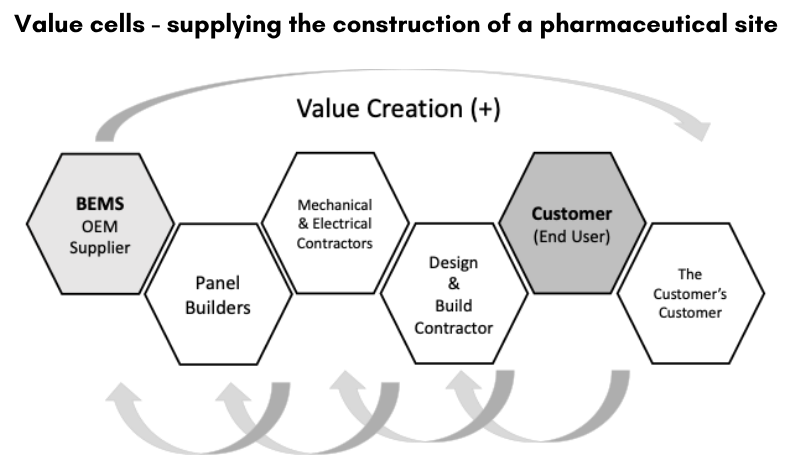
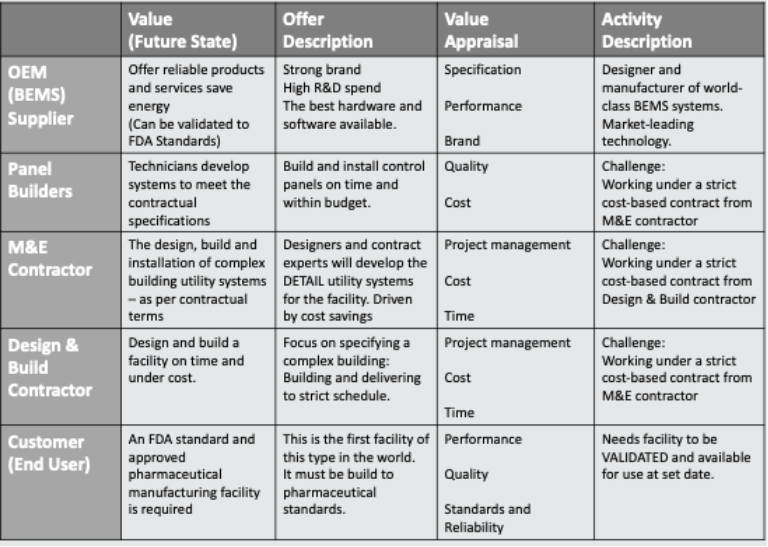
The BEMS supplier manufactured world-class hardware and software. The panel builders built and installed the control systems. The mechanical and electrical contractor oversaw the building utilities. The design-and-build contractor managed the overall project. Each relationship was governed by its own contract. Each contract was cost-focused.
Nobody talked to me about long-term value. Not once.
Nobody said: "If this system fails and delays your FDA approval by two months, what does that cost you?" Nobody said: "If this system performs flawlessly and your validation runs on time, what is that worth to you compared to the fee you are paying us?" Nobody reframed the conversation from a £100,000 engineering contract into a risk-and-return conversation about a £20 million facility build and the downstream commercial consequences of failure.
I would have paid two or three times the contracted fee for a supplier who genuinely understood what was at stake. That value was sitting right there. Nobody reached for it.
Fifteen years later, I was commissioned by that same BEMS supplier to assess their supply chain. I interviewed panel builders, contractors, and channel partners across the network. They were professional, skilled organisations. But the conclusion was unavoidable: nobody in the chain was thinking beyond the organisation they were directly contracted to serve. The end-user and the full value-in-use calculation had completely disappeared from view.
That story is not unusual. I have encountered versions of it in pharmaceuticals, engineering, technology, professional services and facilities management. And I suspect you will recognise something of it in your own markets.
Building supply chains that also build value
I have been revisiting and developing this thinking following a chapter that I wrote previously for the book Malcolm McDonald on Value Propositions (Kogan Page, 2020)
The framework I want to share with you here is built around a single shift in philosophy: from viewing your supply chain as a distribution mechanism to treating it as a network of value-cells.
What is a value-cell?
A value-cell is a supply chain partner that understands, articulates and actively reinforces the value proposition you are taking to the end-user market. It is not just a logistics extension. It is a commercial, technical and sometimes operational partner that speaks your value language and knows how to use it.
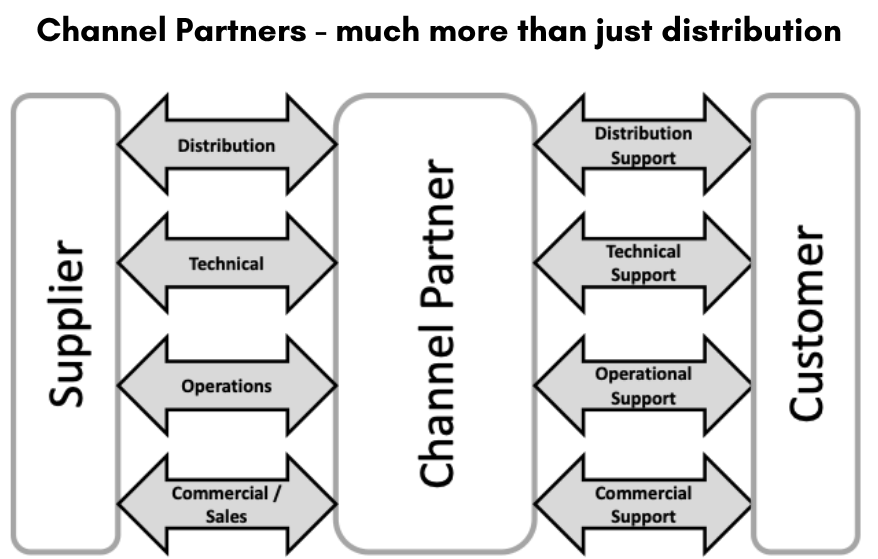
Building this kind of supply chain requires deliberate investment. It does not happen by accident, and it does not happen simply because you have appointed the right organisations. It requires a structured approach. I use a ten-step model that spans three phases: Strategy, Develop, and Operate.
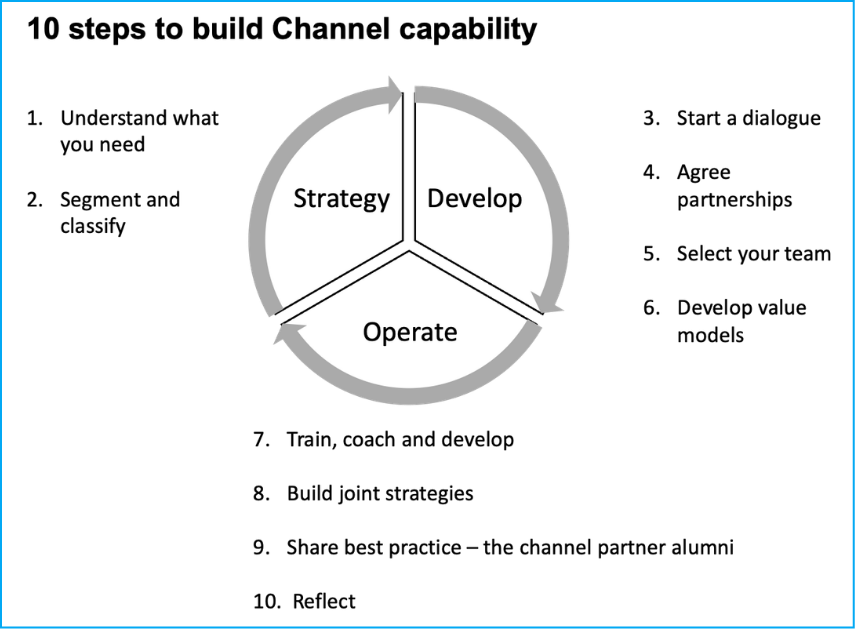
The strategy phase forces you to be honest about what you actually need from your channel partners, how you segment them by impact and intent, and whether you are having the right conversations with the right people in those organisations.
The develop phase is where most organisations fall short. This is where you invest in value models — the tools, frameworks and commercial conversations that allow a channel partner to stop defaulting to price and start having a different kind of discussion with their customers. Training, coaching, joint planning and the gradual construction of a shared language around value.
The operate phase is about sustaining momentum. Supply chain cultures revert. Without constant re-energising — best practice sharing, alumni groups, senior executive conversations — the value-cell philosophy fades and the price conversation returns
Value = Benefits - Total Cost of Ownership
The value equation that underpins all of this is straightforward. Value is the impact you create for a customer, minus the total cost of ownership. The five sources of impact — top-line growth, bottom-line efficiency, business reputation and continuity, strategic and advisory support, and meeting consumer needs — apply not just to your direct customer relationships. They apply at every stage of your supply chain. Every link in the chain has a customer. Every customer has things they genuinely value. The question is whether anyone in the chain is asking what those things are.
When nobody asks, value becomes finite.
The conversation shrinks to price. When someone does ask. When they really ask, with curiosity and commercial intelligence, value becomes infinite. The conversation expands. Relationships deepen. Margins hold.
The difference, in my experience, is not industry. It is not product complexity. It is intention and capability.
Is your supply chain creating or destroying value?
If this resonates, and if you are recognising patterns in your own channels that sound uncomfortably familiar, I would welcome a conversation.
I work with senior commercial leaders across B2B sectors to diagnose where supply chains are fragmenting value and to build practical programmes that address it. We develop value propositions for channel partners, provide commercial training and coaching, segment and strategise the channel, and facilitate executive-level alignment to bring supply chain partners together around a shared approach to value.
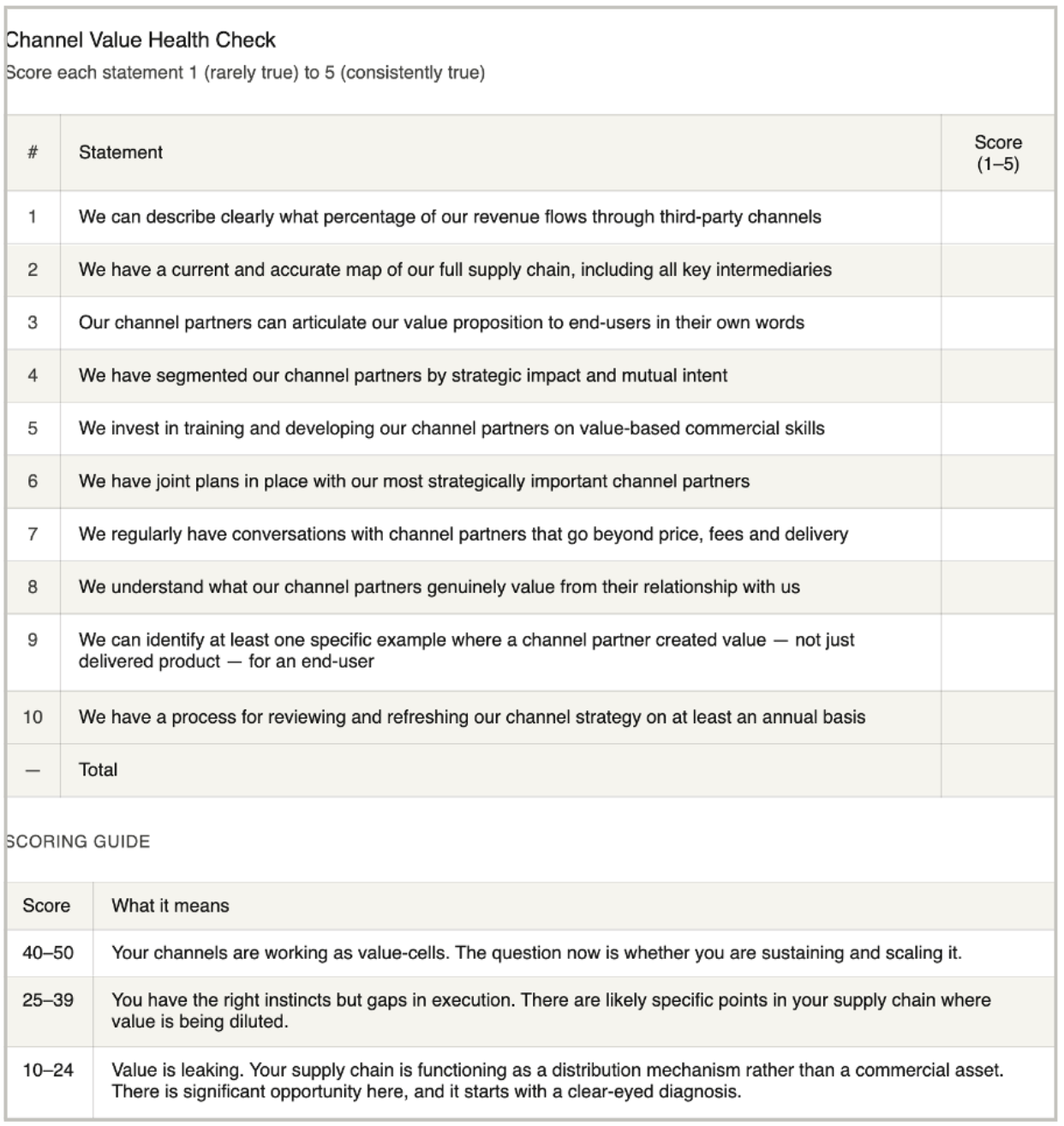
If you would like to assess your own channel strategy partnership approach, have a look at this 10-question diagnostic.
Self-Diagnostic Tool
Assessing your channel VALUE-CELL capability
About me
Mark Davies is Managing Director of Value-Matters, Chairman of AKAM (the Association for Key Account Management), and Visiting Fellow at Cranfield School of Management.
He is the author of Infinite Value (Bloomsbury, 2016) and co-author of Implementing Key Account Management (Kogan Page, 2018).
He is writing his next book, Creating Customer Value Propositions with AI (Kogan Page), alongside co-authors Dr Sue Holt and Richard Brooks.
VALUE-MATTERS | value-matters.co.uk
 |
If this newsletter was useful, please share it with a colleague. If it was forwarded to you and you would like to receive future editions, you can subscribe via the website.


Responses