
And why high-performing Key account Managers should adopt them too.
Business has many forms and many heroes.
So let's talk about one of the very best: Dolly Parton.
Not the rhinestones. Not the wigs. And not the nine-to-five. I want to talk about the fact that she is, by any serious measure, one of the most strategically astute business operators of the last half century. And I want to argue that the principles she lives by are ones that every high-performing Key Account Manager should borrow, without apology.
Dolly Parton was born the fourth of twelve children in a one-room cabin in the Smoky Mountains of Tennessee. No electricity. No running water. Her father, an illiterate sharecropper, paid the doctor who delivered her with a bag of cornmeal (Parton, 2020). She is now the founder of an empire valued at roughly $650 million. She has gifted more than 270 million books to children worldwide through her Imagination Library. And she is a cultural institution so universally admired that she seems to exist in a category entirely her own.
Nashville told her early in her career that her voice was too unusual for country music. She proved them wrong. When her former partner tried to block her from going solo, he sued her. She went anyway, and won. When Elvis Presley's manager demanded 50% of the publishing rights to "I Will Always Love You" in exchange for Elvis recording the song, Parton said no. She kept 100%. When Whitney Houston covered it in 1992, Parton reportedly earned more in a single week than she had in the previous year combined (Bufwack and Oermann, 2003).
She is not lucky. She is deliberate. She is relentlessly, strategically, brilliantly herself.
That is not a throwaway line. That is a business philosophy. And it maps, in ways that will surprise you, directly onto the world of Key Account Management.
The challenge facing Key Account Managers
Key Account Managers occupy one of the most demanding roles in modern commercial life. They are expected to align internal functions that were never designed to focus on a single customer. They navigate buying organisations that are often sceptical of their value. And they are asked to deliver results in a macro-economic environment that shifts without warning and without apology.
Gartner research suggests that around 80% of organisations that attempt to implement Key Account Management fail to generate the returns they anticipated (Gartner, 2022). That is a striking number. It is not, in my experience, because KAM is a flawed concept. It is because organisations misunderstand what it requires, and they misunderstand what kind of person can do it well.
Dolly Parton has three principles she lives and works by. They are disarmingly simple. Hold them up against the reality of senior-level Key Account Management, however, and they are remarkably powerful.
Principle 1
"Find out who you are and do it on purpose"
Here is a question that most organisations never ask seriously: what kind of Key Account Manager do we actually need?
Not "what skills should a KAM have?" That question leads to a competency framework. And competency frameworks, while useful, tend to describe someone who does not exist. They describe a person who is simultaneously a strategic visionary, a gifted relationship builder, a fearless new business developer, and a flawless operational deliverer. No one is all of those things. Not at the same level. Not at the same time.
The business world has long accepted that different leadership situations call for different leaders. Turnaround situations need one kind of person. Growth-stage businesses need another. Post-merger integrations require someone different again. No serious board would appoint the same leader to run a cost-cutting programme as they would to launch a start-up. The profiles are simply different (Collins, 2001).
And yet in Key Account Management, organisations routinely expect every KAM to perform all roles with equal strength. Then they are surprised when performance varies so dramatically across the portfolio.
At Value-Matters, we use a framework called the Tri-Stack model. It maps Key Account Managers across three primary orientations: Strategic, Commercial and Operational.
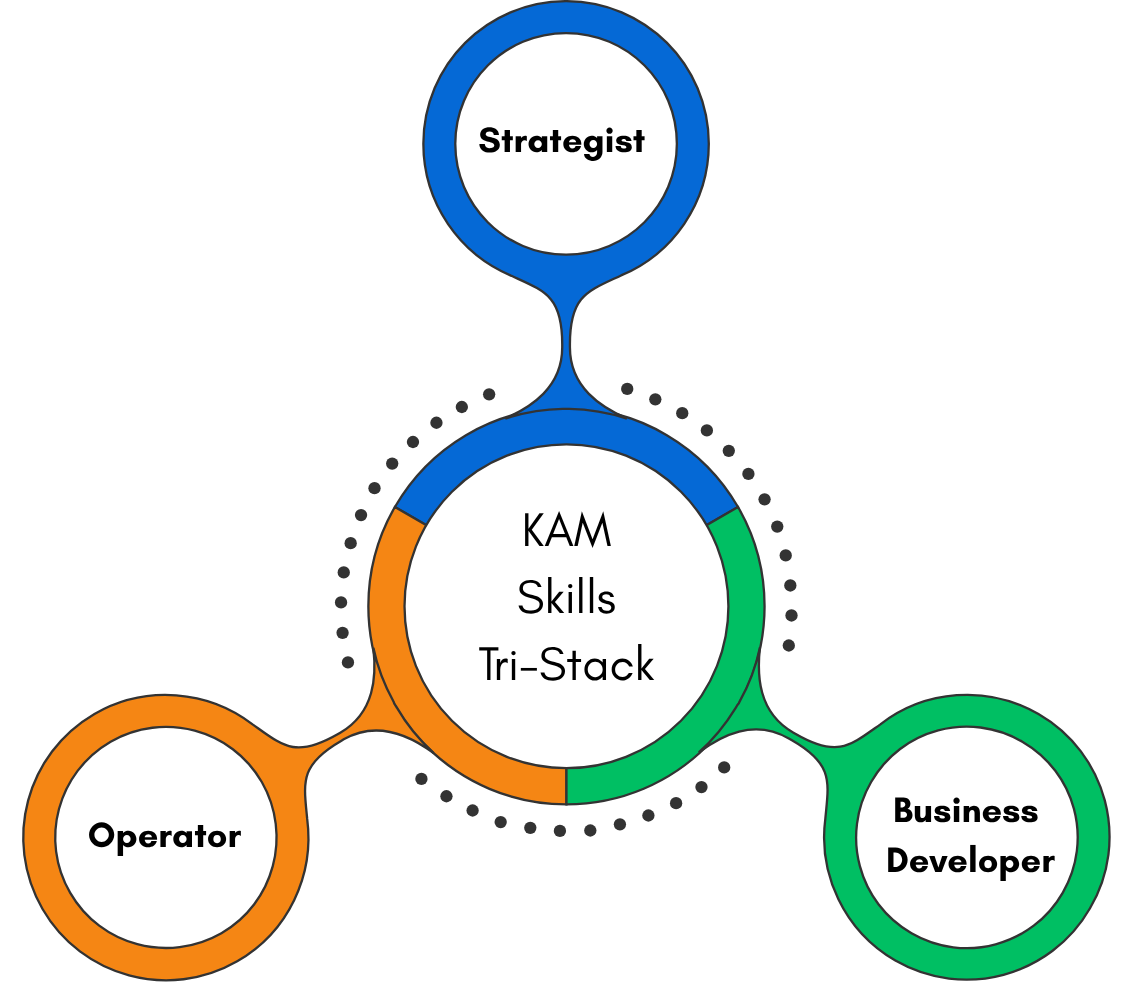
A Strategic KAM brings insight, analysis, and new value propositions for the customer. They think at the level of the customer's business, not just the customer's purchasing department. They are at their best when a key account relationship needs to be repositioned, elevated or fundamentally redesigned.
A Commercial KAM brings strength in persuasion, resilience and the ability to open new doors and develop new business. They thrive on target pressure, the energy of negotiation and the discipline of pipeline management. They are at their best when a key account needs to grow quickly.
An Operational KAM strengthens delivery, process, and reliability. They make complex, multi-site, multi-stakeholder programmes actually work. They are at their best when a key account relationship needs stabilising and consolidating after a major win.
Every KAM has all three. But the most effective KAMs and the organisations that deploy them well are honest about where the primary strength lies and act accordingly.
Dolly Parton understood early that she was not going to out-rock the rockers or out-twang the Nashville establishment. She found the lane that was genuinely hers, she owned it completely, and she built an empire from it. She did not apologise for what she was not. She amplified what she was.
Know your strengths. Know your weaknesses. Know your preferences. Then act on them, deliberately and without apology. Just like Dolly.
Principle 2
Most sales training programmes will not tell you this;
Key Account Management is not selling. It resembles selling from a distance. It shares some of the same vocabulary. But the mechanics, the timescales and the psychology are fundamentally different.
A good salesperson can, in principle, open an account, build a relationship and close a piece of business within a quarter. Their targets are structured around that rhythm. Their incentives reinforce it. Their confidence comes from the regularity of wins.
A high-performing Key Account Manager may work for six, twelve, eighteen months before the strategic groundwork they have been laying translates into measurable commercial return. During that time, they will conduct detailed analysis of the customer's business. They will spend weeks on internal alignment, ensuring that their own organisation understands what the customer actually needs. They will build relationships with senior leaders across the customer who have no immediate purchase authority. They will write business cases, run pilot programmes and attend meetings where nothing is formally decided but where everything important is learned.
Pink (2012) argues that the most effective modern commercial professionals are those who move people from ignorance to understanding, and from inertia to action. That process, in a Key Account context, does not happen in a quarter. It happens over years.
The rain in Key Account Management is real and it is persistent. It is the pilot study that runs for four months and produces inconclusive results. It is the senior stakeholder who cancels three meetings in a row. It is the internal budget review where the KAM's strategic initiative is deprioritised in favour of a quick-win sales campaign. It is what I sometimes call "a thousand cups of tea," the patient accumulation of internal and external conversations that gradually build the understanding and trust from which real strategic progress emerges.
But the rainbow, when it comes, is transformational.
A well-developed key account can represent 5% to 20% of a business's total revenue and profit (McDonald and Rogers, 2017). When a KAM architects the expansion of a relationship at that scale, they are not just delivering a contract. They are delivering a strategic asset. They are reshaping the business.
My advice is to document everything. Every meeting. Every conversation that shifts the customer's thinking. Every piece of analysis that reframes the problem. When the rainbow arrives, others will want to claim it. Success has many fathers, as the old saying goes, but failure is a lonely orphan. The KAM who built the relationship deserves the recognition. Make sure the evidence supports that claim.
Courage is required here, and not only individual courage. Organisations that want the genuine benefits of Key Account Management need leadership courage as well: the willingness to protect their best KAMs from short-term commercial pressure long enough for the strategic work to bear fruit. Without that, even the most capable KAMs will eventually default to transactional behaviour, because typically, that is what their environment rewards and measures.
Dolly put up with a great deal of rain before she saw her first rainbow.
She documented her story carefully, and she owned every part of it. KAMs would do well to follow her lead.
Principle 3
A short story (let me take you back to 2010.)
The world was pulling itself out of the wreckage of the financial crisis. GDP in the United Kingdom had contracted by 4.2% in 2009 (Office for National Statistics, 2010). Construction had collapsed. The housing market was frozen. And a client of mine, a global engineering services business with a strong track record and a well-established value proposition, was finding that their pitch no longer worked.
Their core offer was built around efficiency and output. They helped manufacturing clients run better, produce more and reduce downtime. It was a compelling proposition. In 2007, it had been flying.
In 2010, pitching to one of the world's largest drywall manufacturers, the Group Engineering Director stopped them mid-presentation. "Why would I want to produce more plasterboard?" he said. "In case you haven't noticed, we are in a global recession. Our warehouses are full of stock we cannot sell. The last thing I need is more capacity."
The economic wind had changed direction. My client's sails were set for a different world.
This is the moment where many account teams do one of two things. They either push harder with the same message, hoping that persistence will change the customer's mind. Or they retreat, place the account into maintenance mode and wait for conditions to improve. Neither approach serves the customer, and neither serves the supplier.
High-performing Key Account Managers choose a third option. They go higher. They ask different questions. They listen to different people.
In this case, my client secured a conversation with the Board-level Operations Director, who had oversight of five manufacturing sites across Europe. He was candid in a way the Engineering Director had not been. "Right now," he said, "I have orders that really only justify capacity from three, maybe three and a half sites. We expect the economy to recover and when it does, we will need all five. But right now, I am carrying two sites I do not need."
That single conversation changed everything.
Instead of pitching a solution to a problem the customer no longer had, my client now had genuine insight into the problem the customer actually had. They built a new proposition: optimise the three active sites by 10-15% using their established efficiency methods, and professionally mothball the remaining two sites in a state of readiness that would allow rapid scale-up when demand returned.
The Operations Director embraced it. The work went ahead. And when the recovery came, faster than most people had expected, my client was positioned as the trusted partner who had understood the customer's situation and acted on it. More work followed. The relationship deepened significantly.
The lesson is not complicated, but it requires discipline to apply consistently. Rackham and DeVincentis (1999) argue that the most effective account management professionals are those who create new value for customers by reconfiguring their company's capabilities around changing customer needs, rather than simply delivering what the company was already prepared to sell. That is precisely what happened in 2010. The product did not change. The capability did not change. The understanding of the customer's world changed, and the offer was reframed around it.
The winds are shifting again now. Artificial intelligence is restructuring how organisations think about cost, capability and competitive advantage. Geopolitical instability is disrupting supply chains. Inflation and energy costs are forcing operational decisions that would have seemed unthinkable five years ago. Each of those shifts creates both a threat and an opportunity for Key Account Managers who are paying close attention.
Adjust the sails.
Final thoughts
Dolly Parton did not become a global institution by accident. She became one by knowing who she was, by persisting through years when success was anything but guaranteed, and by reading the landscape around her with a clarity that most people mistake for luck.
High-performing Key Account Managers are built from the same material. They know their strengths and deploy them deliberately. They do the patient, unglamorous work that precedes every great commercial win. And when the environment shifts, they shift with it. As Dolly says:
Storms make trees take deeper roots..
She was not talking about KAM. But she might as well have been.
Keep the conversation going..
- Email me to discuss how the Tri-Stack model applies to your KAM team. [email protected]
2. Connect with me on LinkedIn for weekly insights on Value-Based KAM.
3. Join AKAM (Association of Key Account Management) to keep the conversation going with peers across the profession.
References
Bufwack, M.A. and Oermann, R.K. (2003) Finding Her Voice: Women in Country Music, 1800-2000. Nashville: Country Music Foundation Press.
Collins, J. (2001) Good to Great: Why Some Companies Make the Leap and Others Don't. New York: HarperBusiness.
Davies, M. (2023) Infinite Value: The KAM Leader's Guide to Strategic Account Management. London: Bloomsbury.
Gartner (2022) Key Account Management: Why Most Programmes Fail to Deliver. Stamford: Gartner Research.
McDonald, M. and Rogers, B. (2017) Malcolm McDonald on Key Account Management. London: Kogan Page.
Office for National Statistics (2010) GDP Growth: 2009 Annual Estimate. Newport: ONS.
Parton, D. (2020) Dolly Parton, Songteller: My Life in Lyrics. San Francisco: Chronicle Books.
Pink, D.H. (2012) To Sell Is Human: The Surprising Truth About Moving Others. New York: Riverhead Books.
Rackham, N. and DeVincentis, J. (1999) Rethinking the Sales Force: Redefining Selling to Create and Capture Customer Value. New York: McGraw-Hill.


Responses